PASSOVER / PESACH – March/April
WHAT TIME IN HISTORY WAS PASSOVER
The stories of Exodus happened about 2600 years after Adam, which is about 1400 years before Jesus. [1]
There is approximately 350 years between the end of Genesis and the beginning of Exodus.
There was no written word from God in those approx. 350 years!
Listen to God’s HEART Exodus 3:6-8, Exodus 6:5-8.
I READ INTO THIS THAT GOD IS EXCITED TO BE ON THE BRINK OF HIS REDEMPTION PLAN….
BY THE WAY:-The Rabbis calculate that the plagues, which slowly wore down the Pharaoh’s resistance to God’s plan, could have happened over a period of 10 months to a year. Moses, one of their own, was powerfully used to perform signs and wonders. He pointed prophetically to an even greater deliverer to come. Deuteronomy 18:15-19.
– WHAT ARE THE NAMES FOR THIS 1st FEAST?
– In Hebrew the name is Pesach.
– Pesach comes from the verb, Pasach, which means “to protect”. To hop, skip over, pass over. [1a]
– In English it is known as Passover.
WHERE ARE GOD’S INSTRUCTIONS RECORDED?
Exodus 12:1-14 Then one year later Leviticus 23:4-5, Numbers 9:1-14. Then forty years later Deuteronomy 16:1-8.
WHAT TIME OF THE YEAR IS IT OBSERVED?
God declared ‘Nisan’ to be the first month of the Hebrew year. He instructed Passover to be observed on the 14th day. A one day Feast in the season of early spring. (March/April). Have you considered what a great act of faith it was for the Israelites, to celebrate Passover in Egypt. The people were celebrating their freedom before they had left Egypt! (Faith acts and speaks of that which is not as though it is. Hebrews 11:28.) [2]
HOW LONG WILL PASSOVER BE OBSERVED?
Forever according to Exodus 12:24! The prophet Ezekiel speaks of it being kept into the future. Ezekiel 45: 21.
SOME FACTS:-
– The Passover sacrifice in Egypt was “A protective sacrifice”. It protected the firstborn of the family from certain death.
– The Passover lamb was a peace offering, not a sin offering, and as such it could be eaten. Leviticus 3:1, 7:11,22:29.
– The animal was a one year old male sheep or a goat. It was not a baby lamb, it was the best blemish free, one year old ram in the flock, probably with horns and weighing over 20Kg! (The weight of your holiday suitcase) It was selected on the 10th day of Nisan and kept till the 14th day before being killed. During the intervening days any imperfections would be revealed. [3]
– The month before Nisan (Adar) was sometimes repeated to make a leap year if the barley was not at the correct maturity according to the priests.
– Deuteronomy 16:1 uses the name Aviv/Abib for the month of Nisan. Aviv/Abib in Hebrew means, Young, tender, green/new ears of grain. [1]
– Passover is mentioned 49 times in the Hebrew Scriptures and 27 times in the New Testament This fact alone shows us the importance of this feast in God’s plans. In Acts 12.4 in the KJV – the Greek ‘pascha’ KJV translated the word as “Easter”. Why?
WHAT WAS THE PROCEDURE LIKE DURING THE TEMPLE PERIOD?
Lambs for Temple purposes were raised in Bethlehem. They were led into Jerusalem before the feast. ( 9km). Israelites travelling to the feast from out of Jerusalem could not bring their lambs with them, so they purchased a lamb on the 10th day of Nisan from the Temple authorities and examined it until the 14th day.
Each Israelite then took their lamb into the outer court of the Temple for slaughter.
When the area was full, the gates were closed, the shofar was blown, then a trumpet, and finally the shofar. The priests stood in two lines with silver and gold vessels in their hands. The vessels had no base so that they could not be put down, otherwise the blood would coagulate. Each Israelite performed the slaughter and a priest received the blood, then he gave it to the next priest who passed it on until the vessel was full and an empty one was given back. The priest closest to the altar poured the blood at the foot of the altar. When the first group went out, a second group came in, then a third. Each group repeated the same procedure until no-one was left. Finally, the Hallel was sung (Psalm 113-118) 4. The lambs were then roasted in preparation for the Passover meal.
BY THE WAY:- The historian Josephus records a Passover in the 1st century where more than 250,000 lambs were slaughtered! [5]
HOW COULD JESUS BE A PASSOVER LAMB?
Paul tells us in 1 Corinthians 5:6-8 that Jesus is our Passover Lamb. Why ?
– Because Jesus was born in Bethlehem, the same place where Passover lambs were raised. Micah 5:2, Luke 2:4-7.
– Because Jesus entered Jerusalem on the 10th day of Nisan, [Some say the year was 6th April AD32] the same day as the lambs were led into the Temple courts from Bethlehem. Exodus 12:3, Zechhariah 9:9, Matthew 21:1.
– Because Jesus was examined for 4 days by the chief priests, the elders, the Pharisees and the Sadducees, which was the exact time as the Passover lambs were being examined. Exodus 12:5-6, Matthew 21-22.
– Because the crucifixion was influenced by many people:- Judas, the High Priest, the chief priests, the elders, the council, the false witnesses, Pilate, Herod, and the Roman soldiers. Matthew 26:47-27:37. Luke 22-23. The Passover lamb was to be killed “by the whole assembly of the congregation of Israel”. Exodus 12:6. Note:- God’s plan was that both Jews and Gentiles participate in His death, because He was dying to forgive the sins of both. It is unfair to put the blame on the Jews only. [6]
– Because Jesus died in Jerusalem as was required for a Passover lamb. Deuteronomy 16:5-6. Luke 23:44-46.
– Because no bones were broken in his body as was the requirement for a Passover lamb. Exodus 12:46, John 19:33.
– Because his body was not left till morning as required for a Passover lamb. Leviticus 7:15, 22:29, John 19:31.
– Because Jesus was on the cross from 9am until he died at 3pm. Mark 15:25-37. It is a historical fact that the first lambs were slaughtered at 9am, and the last lambs were slaughtered at 3pm. [7]
– Because Jesus died at Passover towards evening at the same time as the final Passover lambs were being killed. Leviticus 23:5, Luke 23:44-46.
– Because Jesus is central to all of the feasts. He is the one each feast was pointing to and is pointing to in John 5:46-47 and Luke 24:27.

When Jesus was on the cross, Matthew 27:46 tells us that he said, “My God, My God, why have you forsaken me?” John 19:30 tells us that he also said, “It is finished.” It is thought that when he spoke these few words he was in fact doing a very Jewish thing,… quoting the first and last words of a Biblical text. This reminder drew the listener to recall the complete passage. In this instance it was Psalm 22. A psalm which speaks of Messiah’s suffering. Jesus was telling the people who he was!
(Psalm 22:31b can be translated as “It is finished” or He has finished it”.)
In Jesus day Passover was laden with Messianic expectation and filled with prophetic expectation. There was a saying at that time:- “In that night they were redeemed, and on that night they will be redeemed.” [8]
How true that saying proved to be!
OTHER PROPHECIES FULFILLED BY JESUS AT PASSOVER.
– He was rejected. Isaiah 53:3 – John 1:11
– They cast lots for his clothing. Psalm 22:18 – Luke 23:34.
– Pierced his hands and feet. Psalm. 22:16 – Luke 23:33.
– His grave was with the wicked and a rich man. Isaiah 53:9 – Luke 23:50-53.
AN INTERESTING THOUGHT:-
When John the Baptist said, “Behold the Lamb of God who takes away the sin of the world”. John l:29, ‘the lamb’ refers to the Passover sacrifice, which did not take away sin, but redeemed from death. The words, ‘who takes away the sin of the world’ refer to the sacrifice of Yom Kippur. This links Passover with Yom Kippur.
The Lamb of God also refers to Genesis 22:1-14, when Abraham was asked to offer up his son Isaac as a burnt offering in the land of Moriah. After leaving their servants, Abraham and Isaac walked alone towards the place the Lord had told Abraham.
Isaac turned to his father and asked, “I see the knife, I see the fire, and 1 am carrying the wood, but where is the lamb for the burnt offering?” Abraham replied, “God himself will provide the lamb”. The word ‘lamb’ is the word you would have heard when the text was read out in the synagogue. God will provide a ‘lamb’. Abraham bound Isaac, prepared to slay his son, but was stopped by an angel of the Lord. He looked up and saw a ‘ram’ caught in the thicket. As a hearer of the Bible, you heard Abraham clearly say that God himself will provide a ‘lamb’, but He didn’t, God provided a ‘ram’. You actually heard a different word, the word you might have been expecting to hear was not there. And that becomes important, especially in the context of Divine Language, which is how Jewish people consider the text. The question for the hearer now becomes, why did God provide a ‘ram’, when Abraham very clearly said He would provide a ‘lamb’? The Hebraic answer was:- because Abraham was a prophet, God will indeed provide a ‘lamb’, however, He will do so in the future. Thus, from the time of Genesis 22, the Jewish People had been waiting for the ‘Lamb of God’, and this prophetic interpretation began to take on a Messianic character and title. We can see this title active and alive in the psyche of the Jewish people in the 2nd Temple Period, so much so that when John the Baptist sees Jesus, he declares Him to be the “Lamb of God”. The disciples don’t ask, what’s the ‘Lamb of God’? They already know, and many disciples stopped following the
prophet John and started following Jesus, the Lamb of God. [9]
AN INTERESTING POINT.
All sacrifices had to be overseen by the High Priest who would declare, “It is completed”, or “It is finished”, in line with the scriptures. Roman law required a prisoner to have a legal document that had the words Tesli or paid in full written on it when they had finished the prison sentence.
To understand how the High Priesthood was transferred to Jesus, allowing him to announce, “It is finished/accomplished”, (John 19:30), we need to look back to the position of the High Priest.
There were rules laid down within the office of High Priest and one of these was the forbidding of tearing of the priestly robes. Leviticus 21:10. So when Caiaphas tore his robes when Yeshua said He was the Messiah, (Matthew 26:65), his priesthood was invalidated, and everything he did after that, was null and void. He no longer had any authority to oversee the sacrifices of that particular Passover.
The Biblical position of High Priest had to be through a priestly lineage and an anointing of God, (Ex 28:1), but it is a historical fact that Caiaphas was a political appointee made by the Roman authorities. It seems that the position of High Priest moved from the Aaronic line during the time of the Maccabees. They took this role as a reward for their victory over the Greeks when they freed the Temple from the Greeks and rededicated it to God around 168 BCE. 10. NB:- Yeshua was not from
the line of Aaron as was required by the Torah for the earthly Tabernacle/Temple, but He qualified as High Priest under a different (eternal) priestly line, that of Melchizedek to serve in the greater Heavenly Tabernacle/Temple. Psalm 110: 4, Hebrews 7:11-17.
WHY DID JESUS EAT HIS PASSOVER SEDER A DAY EARLY?
This may be hard to get your head around.. . It’s a technicality….
Remember:- a Jewish day begins at sunset.
In Jesus time the Sadducees and Pharisees slaughtered their lambs on different days depending on their interpretation of Exodus 12:1-12, Leviticus 23:5-8, (23:5 In the fourteenth day of the first month at twilight is the LORD’s passover) Numbers 28:16-25.(16“‘On the fourteenth day of the first month the Lord’s Passover is to be held.)
The Sadducees slaughtered their lamb before the 14th, so that it could be eaten during their Passover Seder which began after sunset on 14th Nisan.
The Pharisees slaughtered their lambs on the 14th, and ate their Passover Seder after sundown, which was the beginning of 15th Nisan, which also happened to be the first day of Unleavened Bread – a High Holy Day, a day of rest.
In Jesus’s time the Pharisees had the greatest influence over the people, therefore the majority followed their ‘tradition’. So the Passover Feast and the Feast of Unleavened Bread were, in Jesus time, eaten together after sunset at the beginning of the 15th Nisan.
Jesus however ate his Passover Seder with his disciples shortly after the 14th Nisan began, right after sunset, either in accordance with the scriptures or in line with the Sadducee. He was then crucified and died the same day before sunset on 14th Nisan. He was resting in the tomb at the beginning of the Feast of Unleavened Bread, a day of rest.
It is very possible that there were two back to back Shabbats during crucifixion week.
One being “traditional” Passover/Unleavened Bread Holy day and the other the regular Shabbat, [11]
NOW THAT THE PASSOVER HAS BEEN FULFILLED BY JESUS. IS IT OBSOLETE ?
NO:-
Moses wrote that Passover is to be celebrated generation by generation by a perpetual regulation, forever. Exodus 12:14, 17 & 24.
Ezekiel prophesied that during the time of the new Temple Passover will be kept, Ezekiel 45:21.
Jesus said, he had not come to abolish the Law or the Prophets; …. until heaven and earth disappear, not the least stroke of a pen, will by any means disappear from the Law until everything is accomplished. Matthew 5;17-19.
Luke 22:14-16 – Jesus said Passover will be given its full meaning in the Kingdom of God.
Paul speaks of the feasts as shadows of things that ARE COMING but the body is the Messiah. Colossians 2:16-17 (Some translations say:- these are only a shadow of what was coming…incorrect translation. [12]
Hebrews 10:1 The Torah has in it a shadow of the good things to come… This verse can mean either:- “a shadow of the good things to come”, or “a shadow of the good things which have come”.
HOW DOES PASSOVER RELATE TO OUR CHRISTIAN WALK?
-When we apply the blood of Jesus onto our lives by faith it is the beginning of a new spiritual calendar for us, just as it was for the Israelites. It took faith to apply the blood to the door post and then remain inside, so it takes faith in the shed blood of Jesus for our salvation. Revelation 12:11
– Because Jesus was, ‘The Protective Sacrifice”, those who put their trust in Him can be passed over so the Angel of death/slaughterer/destroyer cannot touch them. We are spared eternal death and the wrath of God. John 17:2. This is both fulfilled and yet to be fulfilled. Free of spiritual death, but waiting to be free of bodily death. It is a free gift for us, but it cost God the life of His Son.
JEWISH PASSOVER TODAY:-
Spring cleaning, any products with leaven removed, products which swell when cooked. Eg; yeast, baking powder, baking soda, rice, pasta, cereal.
Father and children search the house for leaven. They burn any they find.
After sundown a generous formal family meal called a “Seder” takes place all over the world. (Seder means “order” because the liturgy follows a certain order which has remained roughly the same as in Jesus’s time.) [13]
A lamb is no longer killed and eaten. However, a lamb shank bone is placed on the Pesach plate as a reminder of the Passover lamb. The custom these days is to have beef or chicken as the main meal. The evening includes special food, telling the Exodus story, songs, and liturgy.
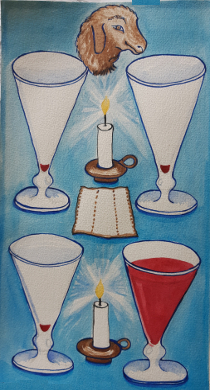
Four cups of wine are drunk during the Seder. They are:-
1. The cup of Sanctification,
2. The cup of Plagues.
3. The cup of Redemption.
4. The cup of Praise. (Exodus 6: 5-8).
Jesus used the cup of Redemption after the supper to say to his disciples, “This cup is the new covenant in my blood which is poured out for you. Luke 22:20.
The four cups were added by Rabbi Hillel, just before the time of Jesus. In the Passover meal that the scriptures describe, we see how the Messiah used the wine cups. That shows us that he submitted to the custom that had recently been incorporated into the feast by Rabbi Hillel. [14]
WHY DID GENTILE CHRISTIANS STOP KEEPING PASSOVER?
Refer to Introduction Notes on the same topic,
– Some Gentile Christians discontinued keeping Passover as early as about 100CE.
– Ignatius of Antioch (50-117 CE) – “Those that participate in Passover are those that participated in the killing of Christ”
– In the fourth century the Council of Nicea decreed that the Lord’s death was not to be celebrated at the same time as the Jewish Passover.
– Constantine wrote that “It would be an unworthy thing for the death and resurrection of the Lord to be celebrated at the same time as the Jewish Passover”.
It came to be celebrated at the time of the pagan festival which honoured the fertility goddess Ishtar (hence Easter). 15.
NOTE:- Jews everywhere have continued to keep the feasts, sometimes secretly, at other times openly, right up to this day.
Many Christians are returning to an understanding of the richness of the meaning of this feast of freedom on their own beliefs. As has already been mentioned in 1 Cor 5:7-8 we are commanded to keep the feast. In fact, all the early believers understood the importance of this biblical feast which carries such a powerful message of redemption.
Summary:
– Deliverance out of the bondage of Egypt.
– Jesus’ death on the tree.
– Repentance and trust in the blood of Jesus.
Sources:
1. Dates recorded in margin of Thompson Chain Reference Bible, 1983, NIV edition, published by Zondervan Bible Publishers. – Lori Eldridge.
la. Strongs Concordance.
2. Dr S.Ketriel Blad Parashah 15. Page 20.
3. Tom Bradford- Torah Studies.
4. Mishnah (Pesachim 5:5-7.)
5. Wars of the Jews: By Flavius Josephus. Book vi, ix, 3.
6. The Feasts of the Lord (YHWH) By Marcia Malthus.
7. Dr S. Ketriel Blad. Parashah 15, Page 12 + What Day of the Week was Jesus Crucified. By Lori Eldridge. Page 3,8.
8. Sitting at the Feet of Rabbi Jesus. Page 104
9. Aaron Eime. Christ Church. Jerusalem.
10. Our Lost Heritage. By Dennis’ McLeod. Page 15.
11. What Day of the Week was Jesus Crucified. By Lori Eldridge. Page 8.
12. Jewish New Testament Commentary, by David H. Stem, Page 611
13. Sitting at the Feet of Rabbi Jesus. By Ann Spangler & Lois Tverberg. Page 104.
14. Dr S. Ketriel Blad. Parashah 15, Page 4
15. Wake Up. By Arno Lamm & Emile Andre Van Beckevoort. Chapter 4
Jenny Milmine 2025.
0. 7 Festivals and a Fast – Introduction
1. 7 Festivals and a Fast – The Festival of Passover
2. 7 Festivals and a Fast – The Festival of Unleavened Bread
3. 7 Festivals and a Fast – The Festival of First Fruits
4. 7 Festivals and a Fast – The Festival of Pentecost or Shavuot
5. 7 Feasts and a Fast – The Festival of Trumpets
6. 7 Festivals and a Fast – The Fast of THE DAY OF ATONEMENT/ YOM KIPPUR
7. 7 Festivals and a Fast – The Festival of Tabernacles
8. 7 Festivals and a Fast – The Weekly Sabbath Festival
9. 7 Feasts and a Fast – Other Information
Other slides in this module:
- Life of Moses – Exodus, Leviticus, Numbers, and Deuteronomy
- 300-year gap between Joseph and Moses
- First 40 years of the life of Moses
- Thutmose I, the Pharaoh or king of Egypt
- Miriam kept eye on Moses after he had been placed as a baby in a boat
- Second 40 years of the life of Moses
- God spoke to Moses out of a burning bush
- Moses was asked to take off his sandals by God
- The third 40 years of the life of Moses
- Aaron’s Staff becomes a Snake
- The ten plagues of Egypt
- 1st Plague – Blood
- 2nd Plague – Frogs
- 3rd Plague – Lice or Gnats
- 4th Plague – Dung beetles
- 5th Plague – Pestilence
- 6th Plague – Boils
- 7th plague – Nut – Egyptian Goddess of the Sky
- 8th Plague – Locust
- Ninth plague – Darkness
- Tenth plague – Firstborn die
- Passover commemorates the Exodus from Egypt
- Moses the friend of God
- Pillar of Cloud by Day
- Pillar of fire by night
- The Chariots of the Egyptian army
- Moses crosses the Red Sea
- Moses’ older sister Miriam sings a song
- Waters of Marah and Elim
- Manna means ‘What Is It?’
- Water from The Rock at Massah
- Moses at Mount Sinai
- The Ten Commandments or Ten Words of God
- The Three groups of Annual Feasts of God
- The Festival of Passover
- The Festival of Unleavened Bread
- The Festival of First Fruits
- The Festival of Weeks or Pentecost
- The Festival of Trumpets or Feast of Shofars
- The Fast of Yom Kippur
- The Festival of Tabernacles
- The Weekly Sabbath Festival
- The Golden Calf, the idol made by Aaron
- Moses with the New Stone Tablets
- 1st five of the Ten Commandments
- 2nd five of the Ten Commandments
- Ark of God
- The High Priest of Israel
- Tabernacle of God
- Aaron and Miriam oppose Moses
- Exploring Canaan by 12 spies
- 37 years in the wilderness
- Aaron’s Rod that budded
- Speak to the Rock “Give Water”
- Death of Aaron
- The Bronze Snake
- Balak Summons Balaam
- Six cities of Refuge for Israel
- Daughters of Zelophehad
- Moses Blesses the Tribes with Three Sermons
- Moses lived for 120 years
- Caleb was the son of Jephunneh
- Joshua – The Fall of Jericho
- Questions and Answers 1-16
- Questions and Answers 17-32
- Questions and Answers 33-49
- Timeline for Life of Moses
- Next Module – Judges or rulers of Israel
- Introduction – 7 Feasts and a Fast
- Weekly Sabbath – 7 Feasts and a Fast
- 7 Feasts and a Fast – PASSOVER
- 7 Feasts and a Fast – UNLEAVENED BREAD
- 7 Feasts and a Fast – FIRSTFRUITS
- 7 Feasts and a Fast – PENTECOST
- 7 Feasts and a Fast – FEAST OF TRUMPETS
- A Fast – YOM KIPPUR
- 7 Feasts and a Fast – 7th Feast – TABERNACLES
- 7 Feasts and a Fast – Other Information
- Rosh Hashanah or Yom Teruah (The Day of the Sounding of Shofar)
- Yom Kippur, means “Day of Atonement”
- The Jewish Festival of Sukkot
- Background Information – Life of Moses
- Resources – Life of Moses