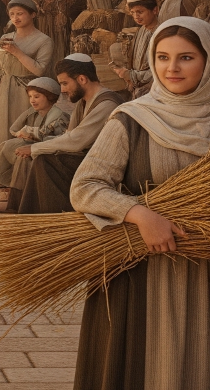
FEAST OF WEEKS / PENTECOST / SHAVUOT – May/June
WHAT ARE THE NAMES FOR THIS 4th FEAST?
Shavuot in Hebrew means Weeks. [1]
Feast of Weeks because it is 7 weeks after the Feast of Firstfruits.
Pentecost is Greek for the Fiftieth day after the Feast of Firstfruits. [1]
WHERE ARE GOD’S INSTRUCTIONS RECORDED?
Leviticus 23:15-21, Exodus 23:16, Exodus 34:22a, Numbers 28:26-31, Deuteronomy 16:9-12, 2 Chronicles 8:13.
HOW LONG IS IT TO BE CELEBRATED?
This feast is to be kept forever. Leviticus 23:21.
WHEN IS IT OBSERVED?
This is a one day, High Holy Day. – Meaning food is prepared beforehand and no work is done.
It was held In late Spring and all males were required to attend in Jerusalem. Numbers 28:26. Exodus 23:14-17, 34:23-24, Deuteronomy 16:16-17. Map
It marked the beginning of the wheat harvest. Therefore no wheat was eaten until first dedicating the harvest to the Lord at this feast in obedience to Malachi 3:8.
It concludes the daily counting of the ‘Omer’ barley offering at the Tabernacle/Temple, which began at the Feast of Firstfruits and continued for 50 days/seven weeks.
(Omer = Heb. – a heap, a dry measure, a sheaf). [1]
it was a feast for rejoicing and remembering freedom from Egyptian bondage.
Deuteronomy 16:9-12 Note:- God commands emotions.
The offering for Pentecost/Shavuot was unique. It consisted of two long, flat, leavened loaves made with the finest wheat flour. The loaves were not burned on the altar because the Lord had forbidden leaven on the altar. Leviticus 2:11, 7:12, 8:2, Numbers 6:15. Instead, these two loaves and two lambs as a peace offering formed the wave offering for the 9am Shavuot service. The priests waved them before the altar, forwards and backwards, then up and down. Afterward, they were set aside “for the priests” ( Leviticus 23:20) and formed the festive meal eaten by the priests later that day in the Temple. 2. Any ideas why 2 loaves?
Pentecost/Shavuot is similar to the feast of Firstfruits because in both feasts bread is waved at the morning 9am service. Unleavened at Firstfruits, leavened at Pentecost/Shavuot.
The ancient Scripture readings for Shavuot are Ezekiel 1:1-28, 3:12, Habakkuk 2:20-3:19.
These date back to the time of the Temple. They describe the brightness of God’s glory. In Ezekiel’s vision, he witnessed wind, fire and voices. Habakkuk saw the Lord coming in fire and bright light. [2]
Offerings on this day included 1 young bull, 2 rams, 7 lambs, plus grain and wine offerings, as burnt offerings. 1 male goat was offered as a sin offering. (Numbers 28:26-31 gives a different number of animals for this feast) All first fruit sacrifices which the people brought were offered on this day also.
The Bible never associated Shavuot with Sinai, but the Rabbis noted in Exodus 19:1, that the giving of the law/commandments had occurred in the third month, very likely 50 days after leaving Egypt. [3]
The traditional reading for this day is Exodus 19 & 20:21 4.- 6 mins. Note v 2: Camp = Hebrew singular = Unity. Verse 14 – separated themselves, washed their clothes, no sex.- (explain why.) No death! God is life and therefore can’t mix with any death.
This conclusion was reached by Rabbi Jacob Milgrom, (1923-2010), who studied Leviticus over his life.
Notice the visual dramatic events:- thundering, (thunders , Hebrew = kole = voices. 1) lightning, fire, smoke, shaking, shofar blast getting louder and louder! Then YHVH, the Lord spoke all the words – Exodus 20:1. In Jewish thinking God’s words were spoken in all the languages of the world. His words were absorbed by everything which meant His words did not bounce back in an echo. Isaiah 55:11 my word that goes out of my mouth….will not return to me unfilled.
A covenant was cut at this time between GOD/JEHOVAH and ISRAEL. We could call it a NEW covenant couldn’t we, since it was different from the covenant God cutwith Abraham. Genesis 15 & 17. It did not change the previous covenant God had made.
This new covenant was cut between GOD/JEHOVAH and ISRAEL. Not with God and a King, not with God and a Ruler/Leader, but with GOD and the people. It was a marriage contract. An engagement. The Hebrew word is a ‘Ketubah’.-(A Hebrew name for a marriage agreement). God describes himself as a husband to Israel in Isaiah 54:5. For your husband is your maker … He also describes Israel as a bride in Jeremiah 2:2. 1 remember your devotion to me when you were young; how, as a bride, you loved me; how you followed me through the desert….He reminds us that the covenant was cut when Israel came out of Egypt in Jer. 31:32…the covenant I made with their fathers on the day I took them by the hand and brought them out of the land of Egypt.
When the Torah was given, man ceased being enslaved. Now he is free. He is free to choose between blessing and cursing. He has the power in his mouth and in his hands to choose between life and death. The people of Israel received that power through the Sinai Covenant. [5]
The terms of this covenant were God’s instructions for how to live in such a way so that He could always live in the midst of them. Exodus 25:8. ..make me a sanctuary, so that I may live among them. The consent to this covenant is recorded in Exodus 19:8, 24:3-8. All the people answered as ONE – “Everything Adonai has said we will do and obey.” They became His people and He became their God. The covenant was engraved on two tablets of stone, Exodus 24:12. This covenant is eternal as recorded in Psalms 119:89, 152, 160, Deuteronomy 7:9. However, they quickly became unfaithful with the golden calf incident and 3000 died as a punishment. Exodus 32:28.
BY THE WAY:-
Remarkably, the book of Deuteronomy is written according to the exact structure of a
covenant:
1. Introduction – the place, time, and persons participating are named- Deuteronomy 1:1-5.
2. Historical Preamble – the reasons for and considerations that have brought the two parties together, Deuteronomy 1:6-4:49.
3. Conditions – the stronger party describes how the commandments are to be carried out and what protection and blessings follow. The weaker party promises to obey and be loyal.
4. Archiving – Where the document is written and kept. Deuteronomy 27: 2-3, Deuteronomy 31:24-26.
5. Penalties – Blessings and curses. Deuteronomy 28-30 (What is unusual in God’s covenant is that grace and reconciliation were central themes.)
6. Witnesses – Deuteronomy 30:19-32:1. [5a]
This feast is connected to Passover because it connects ‘freedom’ to ‘instruction’, something important to us all. Freedom means absolutely nothing if it has no purpose. Exodus 32:16 states that the tablets with the ten words were the work of God, engraved on the tablets by Him. In the Jewish writings of Pirkei Avot (6:2) one of the rabbis states that the word engraving (charut) can be written as freedom (cherut).
That means anyone who is studying and who does God’s Word remains a free human being and will be lifted up. God’s Word gives life and protects freedom, because knowing where the boundaries are liberates us to live. Psalm 119:45. To this day, the Jews call the Torah the “constitution of freedom” and do not think of it as a law. They don’t see it as an obstacle from which they need to feel liberated as many Christians, especially in the West do. [5b]
This feast also relates to the theme of thanksgiving. Thanksgiving for the harvest, and also thanksgiving for the Word of God. Another theme is revelation – the revelation of God himself, His Power, and His Word. [6]
HOW DID JESUS FULFIL THIS FEAST?
Remember each Feast is a shadow of Jesus. Colossians 2:16-17.
Ten days after Jesus ascended into heaven He sent the Holy Spirit to 120 ritually cleansed unified Jewish believers on the very day of Pentecost/Shavuot!
It is no accident that the Holy Spirit was given to empower the life of each disciple and also the whole community of believers, on the holiday connected with the giving of the Torah.
Acts 2. Roaring wind, fire and proclamation about the wonderful works of God in many different languages, announced the arrival of the Holy Spirit to the surprised worshippers who were gathered in unity in one place. (Probably in the Temple area)
Being 9 am, it would have been the hour of prayer and the scripture readings for that day, included, along with others Ezekiel 1:1-28, & 3:12, & Habakkuk 2:20-3:19. 3. The Lord is in his holy temple; let all the earth be silent before him.
With great boldness and revelation Peter explained from the prophets the unusual happenings, and proved scripturally how Jesus is the Messiah, which caused a flood of repentance and 3000 people believed and were baptised immediately! The covenant at Sinai was never meant to be the final one, nor was it possible through it to reach the goal of being eternally in God’s presence. The ancient prophecies of Jeremiah and Ezekiel tell us that. Jeremiah 31:30-36, Ezekiel 36:27. / will put my spirit inside you and cause you to live by my laws, respect my rulings and obey them. A NEW covenant. Like a new moon. Not an actual NEW moon, but seen differently. What had previously been written on tablets of stone was now, about 1500 years later, able to be written on hearts with the help of the Holy Spirit. For this (new covenant) has been given as Torah on the basis of better promises. Hebrew 8:6. David Stern JNT Commentary Page 680, 687.
In Ezekiel 10 we read that just before the Babylonian exile, God’s presence, which has the appearance of brilliance and fire, left the temple in Jerusalem. But on that particular day of Pentecost/Shavuot, something major happened:- God’s presence came back, not into the Holy of Holies of the earthly temple, but with a mighty wind and flames of fire onto the heads of the disciples. The disciples were, after all, the new temple built with living stones, [6]
3000 were added that day, then 5000 men shortly thereafter, throngs of both men and women on another occasion and later a large number of priests. The number of Jewish disciples was continuing to increase.
Acts 2:41,4:4, 5:4 6:1\ 7. Some time later’ the Holy Spirit was poured out on Gentiles, (new grain/harvest), who were grafted into the People of Israel. Acts 10.
HOW IS THIS FEAST SIMILAR TO MY CHRISTIAN JOURNEY?
The meaning of the first Pentecost/Shavuot at Mt Sinai was that God approached a people and came to live with them. He wanted a relationship. He gave them the boundaries that made a relationship possible. Despite their later disobedience, God promised through Jeremiah that there would come a time for a New Covenant, Jeremiah 31:30-37.
Jesus came and cut this new covenant in His blood. The outpouring of the Holy Spirit is the seal/sign of the new covenant. (Ephesians 1:13, sealed by him with the promised Holy Spirit.)
God approached again and, repeating the pattern, His glory returned to His people.
The people from both Israel and Judah and later the Gentiles.
Because God had made the covenant with people, this New Covenant was also made with people, and we as Gentiles can be grafted into Israel as Paul instructed us in Romans 11.
This Feast is fulfilled in us when we are filled with the Holy Spirit and allow God’s word to be progressively written on our hearts. We are, amazingly, God’s temple, the sanctuary in which His Spirit wants to live and wants to feel at home. When the Presence of God comes to our human temple we also need to take the call to sanctify our lives seriously as Paul tells us in 2 Corinthians 6:16-7:1.
In the New Covenant meaning of the Feast of Pentecost/Shavuot, we receive theHoly Spirit, who teaches us and gives us strength, spiritual gifts and fruit. Acts 2:17.
However, we still need to make a choice: Will we follow His Word with all our heart,all of our mind and all of our strength, assisted by His Holy Spirit; or do we rejoice in our “freedom” of Passover/Pesach, but stop on the beach of the Red Sea, while never entering into all the promises and commitments of the Covenant? A believer realises that such choices must be made continuously. It’s an ongoing process between God and man, in which man is free to choose, but never free from the consequences of his choice, [7]
Remember this is an appointment, a set apart day, appointed beforehand by God for a definite purpose, a rehearsal.
What better way than to take time on God’s appointed calendar day of Pentecost/Shavuot to be refreshed in His Holy Spirit. To remember God’s desire to dwell with us and that He has grafted us into His people Israel. To be thankful also for the Word of God and the revelation, which His Holy Spirit brings, revealing God himself, His Power, and His Word, which because of the Renewed Covenant, can be written on our hearts. Thankful also for the harvest. – An excellent time to keep an appointment with Him on his appointed day.
HOW IS PENTECOST/SHAVUOT CELEBRATED TODAY?
“Today Shavuot holiday traditions combine and symbolise both the agricultural and religious importance of the feast. In the synagogue the Book of Ruth is read to describe the grain harvest in ancient times. Homes and synagogues are decorated with flowers for spring. Cheese cakes, honey cakes and other dairy foods are eaten to remember the Land of Israel, which was described as a “Land flowing with milk and honey”.
Honey and milk are also symbols of Torah and learning. The sages describe the study of the Word as being as sweet as honey. In fact, many families, before discussing Torah at home, will place a drop of honey on each child’s tongue (including babies) so the children will always associate the learning of Torah as sweet? [8]
“it is customary today for observant Jews to stay up the entire fright of Shavuot studying and discussing Torah. Traditionally, they study the opening and closing verses of each Shabbat reading, the opening and closing verses of each book of the Bible, and the entire Book of Ruth. Throughout the night there are periodic breaks for coffee and cheesecake. As dawn approaches in Jerusalem, thousands of observant Jews can be seen winding their way from their homes towards the site of the ancient Temple where at the Western Wall plaza they recite the ancient ‘ Amidah’ prayer together.
The Amidah or ‘standing’ prayer with its nineteen blessings dates back more than 2000 years. It forms the central prayer of all prayer services (morning, afternoon, evening, Shabbat and holidays).” [9]
Ezra, Wehemiah, Mordechai, Zerubbabal, Haggai, Zechariah and Malachi along with others, equalling a total of 120, were included in the “Men of the Great Assembly”.
They made important decisions which are still felt today including – Choosing which books to be included in the Tanakh, (eg. Books of Enoch, Judith, Tobit, Maccabees and others not included), Instituting Prayers (the Amidah included), Coordinating the Jewish Calendar, Establishing an educational system in the land of Israel. [10]
BY THE WAY: – The Tanakh consists of three sets of books; Torah, Nevi’im (prophets and histones) and Ketuvim (writing). The ‘Tanakh’ is an acronym: TaNaKh for those three parts. MAY BE READ AMIDAH.
Summary:
– Beginning of the Wheat Harvest and the giving of the Torah at Mt Sinai.
– Pouring out of the Holy Spirit.
– Baptism of the Holy Spirit and growing in faith in God.
1. Strongs’ Exhaustive Concordance of the Bible.
2. The Feasts of the Lord. By Kevin Howard & Marvin Rosenthal. Page 91
3. The Feasts of the Lord. By Kevin Howard & Marvin Rosenthal. Page 95
4. Complete Jewish Bible. By David Stern. Page 1623.
5. Dr S.K. Blad. Parashah 33. Page 2
5a. Wake Up. By Arno Lamm & Emile-Andre Van Beckevoort. Pages 516-518
5b. Wake Up. By Arno Lamm & Emile-Andre Van Beckevoort. Page 279, 290
6. The Biblical Feasts of Israel. By Jesma O’Hara. Page 29.
7. Wake Up. By Arno Lamm & Emile-Andre Van Beckevoort. Page 295
8. Enter His Gates to your Jewish Roots. Susan Marcus. Page 52
9. The Feasts of the Lord. By Kevin Howard & Marvin Rosenthal. Page 97
10. www.jewishhistory.org
Jenny Milmine 2025
0. 7 Festivals and a Fast – Introduction
1. 7 Festivals and a Fast – The Festival of Passover
2. 7 Festivals and a Fast – The Festival of Unleavened Bread
3. 7 Festivals and a Fast – The Festival of First Fruits
4. 7 Festivals and a Fast – The Festival of Pentecost or Shavuot
5. 7 Feasts and a Fast – The Festival of Trumpets
6. 7 Festivals and a Fast – The Fast of THE DAY OF ATONEMENT/ YOM KIPPUR
7. 7 Festivals and a Fast – The Festival of Tabernacles
8. 7 Festivals and a Fast – The Weekly Sabbath Festival
9. 7 Feasts and a Fast – Other Information
Other slides in this module:
- Life of Moses – Exodus, Leviticus, Numbers, and Deuteronomy
- 300-year gap between Joseph and Moses
- First 40 years of the life of Moses
- Thutmose I, the Pharaoh or king of Egypt
- Miriam kept eye on Moses after he had been placed as a baby in a boat
- Second 40 years of the life of Moses
- God spoke to Moses out of a burning bush
- Moses was asked to take off his sandals by God
- The third 40 years of the life of Moses
- Aaron’s Staff becomes a Snake
- The ten plagues of Egypt
- 1st Plague – Blood
- 2nd Plague – Frogs
- 3rd Plague – Lice or Gnats
- 4th Plague – Dung beetles
- 5th Plague – Pestilence
- 6th Plague – Boils
- 7th plague – Nut – Egyptian Goddess of the Sky
- 8th Plague – Locust
- Ninth plague – Darkness
- Tenth plague – Firstborn die
- Passover commemorates the Exodus from Egypt
- Moses the friend of God
- Pillar of Cloud by Day
- Pillar of fire by night
- The Chariots of the Egyptian army
- Moses crosses the Red Sea
- Moses’ older sister Miriam sings a song
- Waters of Marah and Elim
- Manna means ‘What Is It?’
- Water from The Rock at Massah
- Moses at Mount Sinai
- The Ten Commandments or Ten Words of God
- The Three groups of Annual Feasts of God
- The Festival of Passover
- The Festival of Unleavened Bread
- The Festival of First Fruits
- The Festival of Weeks or Pentecost
- The Festival of Trumpets or Feast of Shofars
- The Fast of Yom Kippur
- The Festival of Tabernacles
- The Weekly Sabbath Festival
- The Golden Calf, the idol made by Aaron
- Moses with the New Stone Tablets
- 1st five of the Ten Commandments
- 2nd five of the Ten Commandments
- Ark of God
- The High Priest of Israel
- Tabernacle of God
- Aaron and Miriam oppose Moses
- Exploring Canaan by 12 spies
- 37 years in the wilderness
- Aaron’s Rod that budded
- Speak to the Rock “Give Water”
- Death of Aaron
- The Bronze Snake
- Balak Summons Balaam
- Six cities of Refuge for Israel
- Daughters of Zelophehad
- Moses Blesses the Tribes with Three Sermons
- Moses lived for 120 years
- Caleb was the son of Jephunneh
- Joshua – The Fall of Jericho
- Questions and Answers 1-16
- Questions and Answers 17-32
- Questions and Answers 33-49
- Timeline for Life of Moses
- Next Module – Judges or rulers of Israel
- 7 Appointed Times – Introduction
- 7 Appointed Times – Weekly Sabbath
- 7 Feasts and a Fast – PASSOVER
- 7 Feasts and a Fast – UNLEAVENED BREAD
- 7 Feasts and a Fast – FIRSTFRUITS
- 7 Feasts and a Fast – PENTECOST
- 7 Feasts and a Fast – FEAST OF TRUMPETS
- 7 Feasts and a Fast – YOM KIPPUR
- 7 Feasts and a Fast – 7th Feast – TABERNACLES
- 7 Feasts and a Fast – Other Information
- Rosh Hashanah or Yom Teruah (The Day of the Sounding of Shofar)
- Yom Kippur, means “Day of Atonement”
- The Jewish Festival of Sukkot
- Background Information – Life of Moses
- Resources – Life of Moses