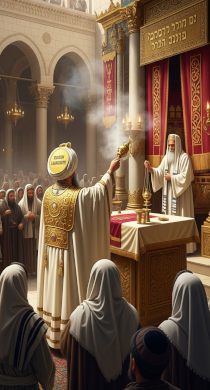
THE DAY OF ATONEMENT/ YOM KIPPUR
WHAT ARE THE NAMES FOR THIS 6th FEAST?
-Yom Kippur = Yom = Day. Kippur – Atonement.
Atonement in Hebrew is Kaparah. Meaning.:- to cover, to cancel, appease, make atonement, cleanse, forgive, be merciful, pardon, purge away, reconcile, [1]
– Face to Face (Panim Panim) The day the High Priest was allowed to enter the Holy of Holies to be in God’s presence, was called: the day to be, “face-to face”.
– The Great Day.
– The Fast.
– The Great Show (Show HaGadol)
Day of Atonement
26 The LORD spoke to Moses, 27 “However, on the tenth day of this seventh month is the Day of Atonement. It’s a sacred assembly for you. Humble yourselves and bring an offering made by fire to the LORD. 28 You are not to do any work that same day. It’s the Day of Atonement, because your atonement is made in the presence of the LORD your God. 29 Anyone who doesn’t humble himself that same day is to be eliminated from contact with his people. 30 I’ll eliminate anyone who does work that day from among his people. 31 You are not to do any work. This is to be an eternal ordinance throughout your generations, wherever you live. 32 It’s a Sabbath of restl for you on which you are to humble yourselves starting the evening of the ninth day of the month. You are to observe your Sabbath from evening to evening.”
WHERE ARE GOD’S INSTRUCTIONS RECORDED?
Leviticus 16 – For the High Priest.
Leviticus 23:26-32. – For the people. Deny yourselves 3x. No work 3x Numbers 29:7-11 – For the sacrifices.’-Regular daily burnt offerings + Burnt offering of – 1 bull, 1 ram, 7 lambs, + grain/oil/wine offerings, +1 goat for a sin offering + Atonement offerings of 1 Bull, + 1 ram + 2 identical male goats.
HOW/LONG IS IT TO BE CELEBRATED?
To be kept forever/everlasting, wherever you live. Leviticus 16:34, 23:31.
WHEN IS IT OBSERVED?
It is observed on the 10th day of the Hebrew month Tishri. It is the climax that the Feast of Trumpets and the Ten Days of Awe with themes of repentance and self-evaluation lead to. Yom Kippur is the most holy day of the Jewish calendar year. A Sabbath of Sabbaths. A day of being humble before God. A day for fasting and complete cessation of work, observed by individuals in their homes and towns. Biblical Yom Kippur is primarily a High Priest day, but the presence of common people was welcome for prayer and observance of the work of the High Priest in the sanctuary.
“Kaparah” (atonement), as we have seen above, means to cleanse that which has been defiled or contaminated. The sanctuary was a place of holiness and of ritual purity which was tainted throughout the year by human beings unknowingly entering it in a state of ritual impurity. If the sanctuary was to function as a holy place, as the dwelling for the Holy One, in the middle of the people, it had to be purged of this impurity annually. This annual cleansing ritual, was what enabled the Holy One to continuously live among the Israelites. This is mercy and grace. 2. God wants to live with people:- Exodus 29:45 I will live with the people of Israel. Leviticus 26:12 I will walk among you and be your God. Ezekiel 37:27. “I will set my sanctuary among them forever, my home will be with them, I will be their God and they will be my people.”
It was absolutely crucial to the nation, that their high priest did not inadvertently become ritually unclean and thereby disqualified from performing his Yom Kippur duties. To safeguard against this disastrous possibility, the High Priest was required to leave his home one week before Yom Kippur and stay in tire High Priest’s quarters inside the Temple area. During the week, the High Priest studied the sacrificial routine. He was twice sprinkled with the ashes of a red heifer to circumvent the possibility that he had- become; unclean through touching a dead body (Such was the normal cleansing process for ceremonial defilement. Numbers 19:1-10). A substitute was also appointed for. the High Priest in the. event he should die or, despite, all precautions, become unclean. This substitute was usually next in line for the High Priest’s office and, as such, the most powerful individual in the Temple after the High Priest. He was the captain of the temple (Acts 4:1, 5:24,26) and exercised direct command of the officers of the Temple guard.
The High Priest did not perform the Temple services on a regular basis, but during the week leading up to Yom Kippur, he alone conducted the sacrifices. All aspects of his duties for the coming holy day were faithfully practised, whether it was sprinkling blood with his thumb and forefinger, burning incense, lighting the menorah, or rehearsing his movements throughout the temple. Yom Kippur was the only time during, the year when the High Priest entered the Holy of Holies in the Tabernacle/Temple. [3]
On the day of Yom Kippur, the High Priest attended to all the daily requirements of the Tabernacle/Temple without help from other priests. First, he dressed in his High Priestly garments to burn the incense, clean the lamp stand and offer on the altar all the daily and Yom Kippur offerings. Throughout the day he changed his clothes 5 times, bathed his body in water 5 times and washed his hands and feet 10 times.
The final service in the afternoon on the Day of Atonement was the most important. It is called the ‘Neilah-Service’ and this means the closing of the gate. This closing of the Heavenly gates is found in the parable of the wise and foolish virgins in Matthew 25:1-13. [4]
Leviticus 16 records exactly how things were to be done by the High Priest at this service and what sacrifices were required. According to a Jewish scholar this is one of the most important chapters of the Books of Moses, because it shows that reconciliation with God is possible, a theme echoed throughout scripture.
Let’s learn by reading Leviticus 16. 1 Bull, + 1 ram + 2 identical male goats.
First the High Priest, dressed himself in four new simple linen garments, then coming out, pressing his hands on the bull as a sign of identification with it as his substitute, he confessed over it all his own sins. Next he cast lots for the goats. The goat which received the lot for azazel was immediately identified with a crimson stripe of wool.
The High Priest returned to the bull, confessed over it the sins of the priesthood, then the bull was slaughtered and its blood caught in a golden vessel and a nearby priest kept the blood from congealing.
Then it was time to go through the Holy Place into the Holy of Holies with burning coals onto which he poured incense making a cloud of fragrant smoke fill the room.
Next he took the bulls blood in, sprinkled it before the Ark of the Covenant. (Once upwards, then 7 times down as if cracking a whip.) After backing out he slaughtered the goat set aside for the people, took its blood into the Holy of Holies and repeated what he had done for the bull. He also smeared some of the bulls blood and the goats blood onto the horns of the altar of incense in the Holy Place. Having made atonement for himself, the priesthood, the people, the Holy Place, the tent of meeting and the altar he then came out to the live goat. He placed both hands onto the head of the live goat, confessed over it all the transgressions, crimes and sins of the people of Israel and sent it away into the wilderness. The High Priest then finished sacrificing the bull and the goat on the altar and their remaining parts were taken outside the camp to be burned. After receiving a message that the live goat had reached the wilderness the High Priest could finish the last of the sacrifices, go into the Holy of Holies, for the fourth time, retrieve the bow of incense, then after coming out, offer the final daily afternoon offering on the bronze altar.
The Great Shofar or Shofar HaGadol was sounded at the end of this Neilah Service, (Isaiah 27:13, Matthew 24:31, 1 Thessolonians 4:i6) it also proclaimed the ‘Year ofJubilee, every 50 years, when all debts were cancelled and all property returned to its original owner. Many expect that the last and great Day of Atonement will coincide with a year of Jubilee. Many rabbis also expect the Messiah to come in a Year ofJubilee and they expect Him to come in our time. [4]
HOW DID JESUS FULFIL THIS FEAST?
JESUS FULFILLED PART of this Day when He took our sins upon himself, suffered and died in our place, as a sin offering, which had been prophesied in Isaiah 53.
Hebrews 1:3, Hebrews 10. He didn’t make atonement for our sins for only another year, but he took them completely away. By his perfect sinless ‘one time’ sacrifice, he made it possible for us to reach the goal of living eternally with God, not Just for the coming year. Hebrews 7:11 [4].
The sacrifice of Jesus atoned for intentional sins, as well as unintentional sins! Something the Sinai covenant could not do. Numbers 15:30.
As Jesus hung on the cross at Passover He was, “The Protective Sacrifice” which protects from certain death.. He was also, “The Lamb that takes away the sin of the world”, and the “High Priest” who carried His own sinless blood into the Temple in Heaven. Hebrews 10:11-14. This connects Passover and The Day of Atonement. Jesus’ blood was not taken into the earthly Temple, but the heavenly Temple, carried by Himself as High Priest after the order of Melchizedek. Hebrews 9, Hebrews 5-7.
Then Jesus sat down – something no earthly priest ever did. He hasn’t come back out yet. Psalm 110:1. Hebrews 10:12, There is no conflict between the two priesthoods. One was for the earthly tabernacle/temple, the other for the heavenly temple.
Historically the earthly High Priest was clothed in a white linen robe that became red with blood from all the sacrifices and the sprinkling. If we follow the pattern of the rituals and if the heavenly and earthly calendars concur, then at his return Jesus could come back to earth at the time of this feast day, when the High Priest in times of old used to come out from the Holy of Holies. The book of Revelation tells us Jesus will be clothed with a garment dipped in blood. (Revelation 19:13-16 sees a future event in which Messiah trod the winepress alone in anger. See Revelation 14:14-20)
TALMUD RECORDS.
It is very interesting reading in the Talmud, (Jewish commentary on the Torah), about a scarlet thread that was tied each year onto both the goat for Azazel and at the Temple entrance during the Yom Kippur procedure.
During the 40 years when Simon the Righteous was High Priest, (2nd Temple period), the crimson thread always turned white. The “lot of the Lord” (the white lot) always came up in the right hand every year for 40 years. The Jews came to believe that if the crimson thread turned white, (Isaiah 1:18) then God approved of the Day of Atonement rituals and Israel could be assured that God forgave their sins.
After Simon the Righteous, the crimson thread would sometimes turn white and sometimes not. The “lot” would sometimes be black and sometimes white. But after 30 CE, the crimson thread never turned white for the 40 year period until the destruction of the and the cessation of all Temple rituals. (The Temple in Heaven is perfect. The earthy Temple will stop to exist).
The Jerusalem Taimud says the following:- “Forty years before the- destruction of the Temple the western light went out, the crimson thread remained crimson, and the lot for the Lord always came up in the left hand. They would close the gates of the Temple by night and get up in the morning and find them wide open.” The Babylonian Talmud also confirmed these events.
Thus in the days of Simon the Righteous the sacrificial system established by God in the Tanakh was observed, and it was effective. But afterwards Israel spiritually declined so that the sacrificial system was effective only sometimes. Finally, after Yeshua’s death, forty years before the destruction of the Temple, it was never effective. The Talmud does not say it, but what had become effective for forgiving Israel’s sin was the sacrificial death of Yeshua the Messiah, [5]
Azazel/scapegoat.
Leviticus 16:8 Some translations say Azazel, some say scapegoat. This is a very controversial verse. The discussion regarding these two identical goats is ongoing,even in Judaism. (Azazel is not mentioned anywhere else in the Bible, but in the book of Enoch he is one of the fallen angels.)
Some think Jesus will fulfil this part of the service when He comes out of the Heavenly Temple and returns to earth. The sending away of the scapegoat, they think, is a shadow of a future event which is yet to happen. The scapegoat, in original Biblical thought, is someone who is the origin of evil and who will eventually have this evil come back on his head. They understand that this scapegoat is the picture of Satan and in a future time, all the transgressions, crimes and sins of the people of Israel will come back on his head, because he is the seducer and he was the origin of all sin. Then he will be taken first to the abyss and finally the Lake of Fire and Brimstone, eliminating any risk of his return. Then everything will come full circle and his head will be finally crushed, as was foretold in Genesis 3:15. The book of Revelation records this happening to Satan in Revelation 20:1-3,10. [6]
Some think the two goats are one and speak of two angles of the Messiah’s death. The blood of one goat is brought into the Most Holy Place to atone, (verses 15-16), and its body is burned outside the camp, (verses 27-28). The other is sent out into the desert, (verses 21-22). (Jesus was taken outside the city to be crucified.
Hebrews 13:11-12.) One goat atones for sin, that is, it satisfies the righteousness of God. Which demands the death of sinners. The other goat removes the sin far away from the children of Israel. Isaiah 53;4, 11-12. [7]
After the destruction of the second Temple in 70 CE and cessation of the sacrificial rites, the question arose:- “How could the people achieve atonement?”
The rabbis ruled that one could perform the Temple duties by reading them, since the utterance of a person’s lips is equivalent to the actual performance of the ritual.
Therefore, the rabbis were convinced that to avert punishment and balance the ledger, a yearly recitation of, the ‘Yom Kippur Temple ritual’, was required, accompanied with repentance, prayer and charity. [8]
So to this day the recitation of the original Yom Kippur ritual is included in the yearly Yom Kippur services. But since the beginning of time a substitutionary blood sacrifice has almost always been required by scripture for atonement for sin. Genesis 3:21, Leviticus 17:11, Hebrews 9:22.
(Exceptions:- Leviticus 5:11-13,Isaiah 6:7). If that was not accomplished then the consequence was death. But without a Temple, there is no way to sacrifice and achieve atonement I Some ultra-Orthodox Jews strongly feel the need for sacrifice so, although criticised, they practise a type of sacrifice by laying their hands, and therefore their sins, on the head of a chicken, swinging it around the head of the [4] person needing atonement, then killing the chicken. This ritual is called, “kaparot”, which means “covering” or “atoning” This practice still happens today and can be witnessed in the. streets of Jerusalem at Yom Kippur. Its persistence today says something about the human instinct that more than just repentance, prayer, charity and recitation of the Yom Kippur /service, is needed to secure forgiveness. To Christians, the need for atonement by Christ’s sacrificial death seems obvious.
God has never regarded sacrifices in themselves capable of removing the guilt of sin in a permanent way. Only those whose hearts are right can offer blood sacrifices that win please God; repentance, prayer and righteousness are necessary preconditions for an acceptable sacrifice, but not a substitute for it. What repentant, prayerful and righteous Jews and Christians must offer God is ‘a sacrifice of praise continually’, thanking Him that Jesus has provided a once-for-all blood atonement for sin. [9]
FUTURE FULFILLMENT
Zechariah 3:9,12:9-13:2. speaks of a -national day of mourning for the nation of Israel when a fountain of cleansing and purging will be opened for them as they recognise their Messiah. Israel is the only nation who will experience this on a national scale Romans 11:25-27 underlines this fact. Could this be on Yom Kippur? Could Yom Kippur be the calendar day on which the whole world will see Jesus face to face as one name for this feast suggests? Ezekiel 20:35, 1 Corinthians 13:12.
We look ahead to its future reality in Christ when our High Priest comes out of the Heavenly Temple and returns to the Mount of Olives on the last great Day of Atonement and all Israel will be saved. [4]
Remember:- Tradition says the first day of Elul was the time that Moses climbed Mount Sinai for the second time to plead for the people for 40 days before the face of God. The people waited fearfully at the foot of the mountain, wondering if God was going to forgive their idolatry with the golden calf. After 40 days the people saw Moses “return-’ with his face shining so brightly he needed to wear a veil. Ex.34:29-35. That 40th day was then called the ‘Day of Atonement/Yom Kippur’ and God reconciled with Israel in His mercy. Could this be the calendar date on which the whole world will see Jesus face to face? Ezekiel 20:35, 1 Corinthians 13:12.
When Moses descended the first time he saw Israel in rebellion and sin, which is the same as happened when Jesus came 2000 years ago. At the second descent the Israelites were not in rebellion and Moses’ face shone with the Glory of God. Moses also brought with him the instructions for building the Tabernacle where God could dwell in ‘the middle of the people”. (John 1:14 Jesus Tabernacled with us) This second descent points to the glorious coming of Jesus, on the Day of Atonement, when His coming will light up the sky from east to west I Matthew 24:27. And just as Moses built the tabernacle, Jesus will tabernacle among mankind and rule and reign in His Messianic Kingdom. [10]
HOW IS THIS FEAST SIMILAR TO – MY CHRISTIAN JOURNEY?
Although not Jewish, maybe we can keep this appointment day with God. We could put aside our program, humble ourselves with fasting, prayer and spend time with our Creator. We could pray for Israel’s salvation, pray for our family, our community and our nation, in preparation for the inevitable ‘Face to Face’ encounter we will all have with our Creator soon. Maybe we can take time to remember that Jesus is our High Priest and through His sacrifice as, ‘The Lamb who takes away the sin of the world’, we are made righteous and acceptable. (Not by any merit of ourselves.) We can appreciate, praise and worship our Messiah, looking forward to His return on this particular day in the not too distant future.
HOW JEWS KEEP YOM KIPPUR. TODAY
The day before Yom Kippur is set aside for preparing for the holy day.
‘Many”have.the custom to immerse in a “mikvah” on this day. [Mikvah is the Jewish ritual bath used for spiritual purification] Extra charity is given.
Honey cake is enjoyed.. Two festive meals are eaten, one in the afternoon and another right before the commencement of the fast. At the second meal it is customary to bless the children with the Priestly Blessing, Numbers 6:22-27.
Holiday candles” are lit before Yom Kippur begins. White is the typical to wear in memory of the High Priests white linen garments.
Like Shabbat, no work is done on Yom Kippur, from the time the sun sets on the 9th of Tishri until the stars come- out in the-evening of the next day. For 26 hours Jews “afflict- their souls”, they abstain from food and drink, do: not wash- or apply lotions or creams, do not wear leather footwear, and abstain from marital relations.
The day is spent mostly in the synagogue, Where five prayer services are held, dedicated to introspection, prayer and asking God for forgiveness.
The final “Closing of the Gates” service at sunset, (NeiJah) ends with the resounding cries of the Shema prayer, Deuteronomy 6:4, followed by joyous song and dance, after which a single blast is blown on the shofar, followed by the proclamation, “Next year in Jerusalem”.
Jews partake of a festive after-fast meal, making the evening after Yom Kippur a festival in its own right.
Jewish sources say that although Yom Kippur is the most solemn day of the year, it is suffused with an undercurrent of joy; it is the joy of being immersed in the spirituality of the day and expresses confidence that G-d will accept our repentance, forgive our sins and seal our verdict fora year of life, health and happiness, [11]
After -Repentance comes -Reconciliation -and Restoration. -It is only then that we can move to the message of Tabernacles/Sukkot, which is rejoicing.
Summary:
– The Holiest- Day. National forgiveness for Israel maybe.
– Maybe the day of the Messiah’s second coming when everyone will come ‘Face to Face’ with their Creator.
– Yielding ourselves to God so we can live ‘Face to Face’ in His presence each day.
Sources:-
1. Strongs Exhaustive Concordance of the- Bible.
2. myjewishlearning.com.
3. The Feasts of the Lord. By Kevin Howard & Marvin Rosenthal. Page 121.
myjewishlearning.com. The JPS Guide to Jewish Traditions.
4. Jewish- New- Testament Commentary. By David- H Stem-.- Page 680-
5. Jewish. New Testament Commentary; By David H Stern-. Page 84.
http:/Zwww.windowview.org/hmny/pgs/ta!muds.30ce.html
6. WakeUp. By Arno Lamm & Emile-Andre Van, Beckevoort. Page 348-351, Page 330, Page 397, Page 371
7. Dr S. Ketriel Blad. Parashah 29, page 8.
8. myjewishlearning.com. The JPS.Guide io Jewish’ Traditions.
9. Jewish New Testament Commentary. By David Stern. Page 697-699.
10. Jesus plus nothing.com Jesus in the Feasts of the- Lord. By ! Gordon.
11. Chabad.org.
Jenny Milmine 2025
0. 7 Festivals and a Fast – Introduction
1. 7 Festivals and a Fast – The Festival of Passover
2. 7 Festivals and a Fast – The Festival of Unleavened Bread
3. 7 Festivals and a Fast – The Festival of First Fruits
4. 7 Festivals and a Fast – The Festival of Pentecost or Shavuot
5. 7 Feasts and a Fast – The Festival of Trumpets
6. 7 Festivals and a Fast – The Fast of THE DAY OF ATONEMENT/ YOM KIPPUR
7. 7 Festivals and a Fast – The Festival of Tabernacles
8. 7 Festivals and a Fast – The Weekly Sabbath Festival
9. 7 Feasts and a Fast – Other Information
Other slides in this module:
- Life of Moses – Exodus, Leviticus, Numbers, and Deuteronomy
- 300-year gap between Joseph and Moses
- First 40 years of the life of Moses
- Thutmose I, the Pharaoh or king of Egypt
- Miriam kept eye on Moses after he had been placed as a baby in a boat
- Second 40 years of the life of Moses
- God spoke to Moses out of a burning bush
- Moses was asked to take off his sandals by God
- The third 40 years of the life of Moses
- Aaron’s Staff becomes a Snake
- The ten plagues of Egypt
- 1st Plague – Blood
- 2nd Plague – Frogs
- 3rd Plague – Lice or Gnats
- 4th Plague – Dung beetles
- 5th Plague – Pestilence
- 6th Plague – Boils
- 7th plague – Nut – Egyptian Goddess of the Sky
- 8th Plague – Locust
- Ninth plague – Darkness
- Tenth plague – Firstborn die
- Passover commemorates the Exodus from Egypt
- Moses the friend of God
- Pillar of Cloud by Day
- Pillar of fire by night
- The Chariots of the Egyptian army
- Moses crosses the Red Sea
- Moses’ older sister Miriam sings a song
- Waters of Marah and Elim
- Manna means ‘What Is It?’
- Water from The Rock at Massah
- Moses at Mount Sinai
- The Ten Commandments or Ten Words of God
- The Three groups of Annual Feasts of God
- The Festival of Passover
- The Festival of Unleavened Bread
- The Festival of First Fruits
- The Festival of Weeks or Pentecost
- The Festival of Trumpets or Feast of Shofars
- The Fast of Yom Kippur
- The Festival of Tabernacles
- The Weekly Sabbath Festival
- The Golden Calf, the idol made by Aaron
- Moses with the New Stone Tablets
- 1st five of the Ten Commandments
- 2nd five of the Ten Commandments
- Ark of God
- The High Priest of Israel
- Tabernacle of God
- Aaron and Miriam oppose Moses
- Exploring Canaan by 12 spies
- 37 years in the wilderness
- Aaron’s Rod that budded
- Speak to the Rock “Give Water”
- Death of Aaron
- The Bronze Snake
- Balak Summons Balaam
- Six cities of Refuge for Israel
- Daughters of Zelophehad
- Moses Blesses the Tribes with Three Sermons
- Moses lived for 120 years
- Caleb was the son of Jephunneh
- Joshua – The Fall of Jericho
- Questions and Answers 1-16
- Questions and Answers 17-32
- Questions and Answers 33-49
- Timeline for Life of Moses
- Next Module – Judges or rulers of Israel
- 8 Appointed Times – Introduction
- 8 Appointed Times – Weekly Sabbath
- 7 Feasts and a Fast – PASSOVER
- 7 Feasts and a Fast – UNLEAVENED BREAD
- 7 Feasts and a Fast – FIRSTFRUITS
- 7 Feasts and a Fast – PENTECOST
- 7 Feasts and a Fast – FEAST OF TRUMPETS
- 7 Feasts and a Fast – YOM KIPPUR
- 7 Feasts and a Fast – 7th Feast – TABERNACLES
- 7 Feasts and a Fast – Other Information
- Rosh Hashanah or Yom Teruah (The Day of the Sounding of Shofar)
- Yom Kippur, means “Day of Atonement”
- The Jewish Festival of Sukkot
- Background Information – Life of Moses
- Resources – Life of Moses