
THE FEASTS OF THE LORD – INTRODUCTION
|
WHAT ARE THE NAMES OF THE FEASTS? |
||||||||||
| The Feast of Passover – 14th Nisan | Pesach. | Spring. Former rain | ||||||||
| The Feast of Unleavened Bread | Matzah. | Spring. Attendance for males. | ||||||||
| The Feast First Fruits | Ha’Bikkurim. | Spring. Barley. | ||||||||
| The Feast of Pentecost – 3rd Sivan | Shavuot or feast of weeks. | Spring. Wheat. Attendance for males. | ||||||||
| The Feast of Trumpets. | Rosh Hashanah. | Autumn. Later rain | ||||||||
| The Fast of Day of Atonement. | Yom Kippur. | Autumn. | ||||||||
| The Feast of Tabernacles. | Sukkot. | Autumn. All the rest. Attendance for males. | ||||||||
The agricultural feasts were not all kept during the 40 years of desert wandering.
You can work out the time of the year events happened like in the book of Ruth knowing when the Barley harvest and Wheat harvest was. Jesus followed the written Law of Moses not the Oral Law of the Jewish leaders of the time.
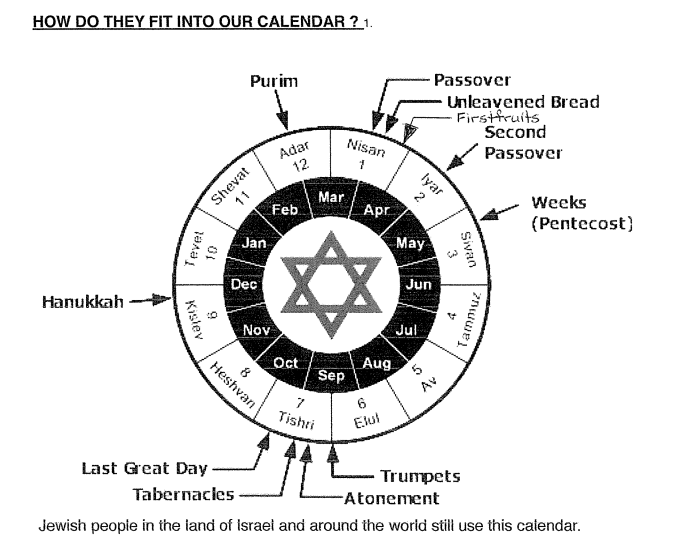
SEVEN FEASTS IN THE FIRST SEVEN MONTHS OF THE JEWISH YEAR.
– Four in Spring, (March April, May)
– Three in Autumn (September October).
– Between are about 6 long, hot, rain free summer months of harvest.
– Seven extra Sabbaths hidden within the Feasts.
FUN FACTS:-
The calendar we use today is a solar calendar which has evolved to replace a complicated Roman lunar calendar. By about 40 BCE discrepancies were observed, so with advice from an Alexandrian astronomer, Julius Caesar introduced the Egyptian solar calendar and renamed it the Julian calendar. However over time, a ten day seasonal shift was observed.
Therefore in 1582, Pope Gregory reformed the calendar to better align it with equinoxes and solstices. (Equinox= the 2 days per year when there is equal daylight and darkness at all latitudes. Solstices=the 2 days per year when it is either the longest day/shortest night, or the shortest day/longest night.)
The Gregorian calendar began to be used in Great Britain in 1752. [1]
The Hebrew year reflects a compromise between lunar and solar reckoning. The difference between a lunar year and a solar year is approximately eleven days. To reconcile this difference the Jewish calendar is based on a 19 year cycle which includes seven leap years. [2]
GOD’S TIMING AND CALENDAR ARE DIFFERENT FROM OURS.
In God’s timing a day is from sundown to sundown. Genesis 1: 5. 8,13, 19, 23, 31. Leviticus 23:32. A new day starts when 3 stars are visible to the naked eye in the sky. (3 witnesses) Hebrew months are lunar; that is, they are based upon the appearance of the thin crescent of the new moon. Genesis 1:14. The sun, moon and stars were given for signs, seasons, days and years. Biblical months are 30 days each. A Biblical year consists of 360 days or twelve 30 day months. This is why the feasts move around from year to year on our 365 day solar calendar. [3]
GOD WORKS IN CYCLES AND REPEATING PATTERNS.
WE TEND TO THINK IN A LINEAR WAY.
– God works with weekly cycles of 7 days.
– Weekly cycles of seven weeks (Passover to Pentecost)
– Monthly cycles, with the seventh month being Holy.
– Cycle of seven feasts within seven months.
– Annual cycles, with the month of Nisan being the first month of the religious year.
– Yearly cycles with the seventh year being a sabbatical or Shmita in Hebrew.
– Yearly cycles of 50 years, with the 50th year being a Jubilee year.
WHERE ARE THE FEASTS FIRST MENTIONED IN SCRIPTURE?
Exodus 12, + 23:14-17.- 3500 years ago as Israel left Egypt and at Mount Sinai.
Leviticus 16 + 23. – Expanded instructions for all feasts.
Numbers 28 + 29. – Expanded instruction, especially for sacrifices required.
Deuteronomy 16. – 40 years later, on the far side of the Jordan River.
Only in Leviticus 23 are all seven feasts listed in chronological sequence. It would be helpful if you read this entire chapter in preparation for these studies.
WHOSE FEASTS, ARE THEY?
Read Exodus 12:11b- My Passover. Leviticus 23:1-2+4,
KJB = The Feasts of the Lord (x2),
Holy convocations (x2),
My (God’s) Feasts.
NOTICE: – These are not ‘Jewish Feasts’ rather, “The Feasts of the Lord” or “My Feasts.”
These feasts do not originate with the people of Israel, but with God. The people of Israel have not come up with these feasts. They are revealed by heaven. These are God’s feast and his people have been able to take part in these occasions that are important to Him. In His program of feasts, He has revealed the whole plan for the redemption of the world. [4]
They belong to Him. And only on His terms and at His invitation can men participate in them and benefit from them.
They were given to the Hebrew nation. God’s covenant people.
They typify the sequence, timing and significance of the major events of the Lord’s redemptive career, from His death to His second coming. [5]
NOTE: – A Permanent regulation or Forever: – Passover – Exodus 12:14, Unleavened Bread – Exodus
12:17,24, First fruits – Leviticus 23:14, Pentecost – Leviticus 23:21, Day of Atonement – Leviticus 23:31, Tabernacles – Leviticus 23:41. notice The Feast of Trumpets is missing.
WHAT DOES THE WORD FEAST OR CONVOCATION MEAN IN HEBREW?
Many words in the Hebrew language need several words in English to get the correct meaning.
So too with the word, FEAST or convocation. We don’t quite get the meaning with our one English word.
Feast Hebrew
1. Moed – An appointment, a fixed time or season, festival.
– An assembly convened for a definite purpose.
– Also a signal (appointed beforehand), (appointed sign), (appointed time).
2. Chag – to move in a circle, ie. to march in a sacred procession, – to observe, festival, celebrate, dance, reel to and fro.
Convocation [Public meeting] Hebrew Miqra – Something called out, ie – a public meeting-the act, the persons, the place. – A rehearsal, assembly, calling and reading. [6]
This teaches us the importance of gathering together on these God appointed times. They are rehearsals for something greater… will we be ready, if we haven’t attended the rehearsal?
Let’s now look at the word SEASONS in Genesis 1:14 This word can mean spring, summer, autumn, winter, but surprisingly it is the Hebrew word:- Moed I Exactly the same word as Feast! God uses His heavenly creation to let us know when His Feast days are happening! They all happen according to the sun, moon and stars. The sun because it marks the days, the moon because it marks the beginning of the months and particularly a couple of special months which we’ll learn about in our study. The stars because they establish when a new day starts according to Hebraic thinking.
We will find out during our study, that the feasts are days of special significance, when God has intervened in history, and He will continue to intervene until His entire plan is fulfilled. Psalm 104:19 You made the moon to mark the seasons. Seasons = Heb= Moedim = Feasts (plural).
Psalm 50:6 & Psalm 97:6 say “The heavens declare His righteousness”. His righteousness is His saving will towards his people, His justice, His faithfulness to His covenant. We will see that His Feasts, happening at the right time according to the sun, moon, and stars will proclaim His salvation, His justice and His covenant. [7]
By The Way:- The 5 Books of Moses are known to Jewish people as Torah We are going to be using these books in this series.
Torah is something vastly more than a law code,
Torah was never a legal text as we might think of it.
The Hebrew word for Torah is:- ‘Yarah or Yara’. It means 2 things:-
1. To point out (as if with a finger) to teach, direct, inform, instruct, like an archer.
Torah is more generally like ‘instruction’. It’s taken from a root word (Yarah) which means “to show something”.
We also get the word “teacher” (moreh, morah) from this. The one who makes us to see and makes us understand.
Like a guide who can point out safety hazards that you wouldn’t notice in an unfamiliar environment.
God’s Torah shows us the problems that we are prone to face and instructs us on how to navigate them. [April-October dry heat]
It’s a gift from God to His people – like a guide.
2. To flow as water i.e. as rain). (Strongs Concordance 3384, 8451.)
The Hebrew word Torah is related to the autumn rains, (yoreh),
Israel has a long dry season from mid April until October. Imagine the desperation felt for these first new drops of rain after months of dry heat!
The dependence we have on His Word is not dissimilar from our need for the heavens to shower the earth.
So how can we read Torah like the Psalmists, who delighted and rejoiced in what might look to us as a bunch of legal codes?
We have to see that it’s trying to show us something- and to shower us with something: –
THE HEART OF GOD HIMSELF.
The Torah shows us what matters to the God of Israel, and guides us into ‘times of refreshing’ that only He is faithful to bring about in our lives. It’s a gift from God to His people – like a guide or much needed rain. [8]
DID JESUS ATTEND THE FEASTS?
YES:
– At Passover as a child with his observant family. – Luke 2:41
-At Passover/Pesach- Matthew 20,21, Mark 10:32-end, Luke 2:41, 9:51-end, John 2:13, 6:4, 11:55-end
– A Festival in Judea – John 5:1 (Probably Tabernacles/Sukkot)
– At Feast of Tabernacles/Sukkot – John chapter 7-9
– At Hanukkah – John 10:22.
Jesus said that Moses wrote about HIM, John 5: 37-47 and Luke 24:27 and Luke 24:44
Jesus explained things written about himself, starting with the writings of Moses. Luke 24:27 and Luke 24:44
Jesus said, “Do not think that I came to abolish the Law/Torah or the Prophets; I have not come to abolish them but to fulfil them. For truly I tell you, until heaven and earth disappear, not the least stroke of a pen, will by any means disappear from the Law until everything is accomplished. Therefore anyone who sets aside one of the least of these commands and teaches others accordingly will be called least in the kingdom of heaven, but whoever practices and teaches these commands will be called great in the kingdom of heaven.” Matthew 5;17-19 NIV.
ARE THERE OTHER VERSES IN THE NEW TESTAMENT ABOUT THE FEASTS?
The feasts all revolve around a person known in Hebrew as MASHIACH, (MESSIAH). He was the prophet that God promised to raise up as a deliverer like Moses. Deuteronomy 18:15-19.
The New Testament confirms that the first three feasts were fulfilled by Jesus the Messiah.
– Passover Lamb – 1 Corinthians 5:6-8.
– Unleavened Bread – Matthew 26:26, Mark 14:22, Luke 22:19, 1 Corinthians 11:23-24.
– Firstfruits – 1 Corinthians 15:20-24.
– Pentecost/Shavuot – The Holy Spirit filling. Matthew 3:11, John 14:16, Act 1: 3-5, Acts 2:1-47
What about the last 3 feasts? They are waiting to be fulfilled in the future.
– Trumpets/Yom Teruah/Rosh Hashanah.
– Day of Atonement/Yom Kippur – Partially fulfilled, John 1:29, Hebrews 1:3, Hebrews 4-10 Partially to yet be fulfilled. Hebrews 4-10, Hebrews 2:8.
– Tabernacles/Sukkot. Hebrews 4:9.
Could the feasts be prophetic pictures of what is going to happen in the future?
Remember we noted earlier that these Feasts are forever.
Ezekiel 40-48 Speaks of a Temple with sacrifices for Shabbat, New Month, Passover, Tabernacles. [New Temple New earth and city]
These are a shadow- Colossians 2:17
Zechariah 14:16 informs us that the feast of Tabernacles will continue in His New kingdom.
Luke 22:15-16 indicates there is a fuller meaning in the kingdom of God for Passover.
Colossians 2:16-17 Each feast has in it shadows/type of things to come and they are all about
Messiah. Some translations say…only a shadow, that’s an incorrect translation. According to David H. Stern:- The word ‘only’ depreciates the Feasts, and Paul the writer, values Jewish practices; he himself observed them all his life. The word ‘only’ has been inserted into the text. If one is going to add to the inspired text, the word to add is ‘definitely’ or ‘indeed’. “These are definitely a shadow of things to come”. [9]
Hebrews 10:1 The Torah has in it a shadow of the good things to come… This verse can mean, a shadow of the good things to come, or which have come. Remembering that the word “convocation” means “rehearsals”. Is it possible that we need to pay more attention to the rehearsals? [10]
BY THE WAY:- When we are studying the Feast we need to keep several time zones In our thoughts.
1. The time the instructions were given on Mount Sinai 3500 years ago.
2. The time of Jesus and how He has fulfilled some of the feasts with exact timing.
3. Our time and how the feasts mirror our journey from salvation through to when we meet the Lord God at the end of time.
WHY DID THE FEASTS NOT CONTINUE INTO THE CHRISTIAN CHURCH?
– Starting from Acts 2 with the outpouring of the Holy Spirit at the Feast of Pentecost/Shavuot, the gospel went back to air the countries the men had traveled from. The gospel spread East, West, North and South.
No doubt many Gentiles, in their home countries, heard the good news from these Jewish men and were welcomed into the believing community. Their Biblical instruction occurred at the local synagogue they attended. They are historically recorded on synagogue attendance rolls as “God Fearers”. Not “proselytes” because they didn’t get circumcised. They had come out of idol worshipping cultures to serve the Living God.
– The New Testament records letters written to these combined Jewish/Gentile congregations. Writings to teach, instruct, correct, encourage and strengthen these congregations.
However, the political atmospheres changed… Claudius expelled all Jews from Rome in 41-53CE, therefore, there were no Jews in the congregation in Rome for a certain period. Acts 18:1-2.
Gentile Christians were being cut off from their Jewish roots and Hebraic ways of thinking.
Once the church was cut off from its Jewish roots, more and more pagan practices were adopted into its worship.
– Paul complained to Timothy that, “Everyone in the province of Asia has turned against me”. 2 Timothy 1:15.
– The Apostle John mentioned a leader, named Diotrephes, who refused to welcome the Apostles. Diotrephes spoke against the Apostles maliciously and excommunicated anyone who wanted to associate with them. (3 John v 9-10.)
It would seem that a rift between Jewish and Gentile believers had begun.
– Then Jerusalem was destroyed in 70 CE and Jews were forbidden to live there. Some early Gentile Christians saw the destruction of the Temple as a punishment to Jews for the crucifixion of Jesus, and by extension, as an affirmation that Christians were God’s “new chosen people”. One writer of these thoughts was Justin Martyr (100-165CE)
Other early Gentile Church leaders had a negative tone or hatred towards the beliefs and traditions of the founding Jewish fathers.
– Ignatius of Antioch who lived between 50-117 CE, wrote, “Those that participate in Passover are those that participated in the killing of Christ”. This indicates that the Lord’s Feasts were being lost to the Gentile Christian Church in some areas. Jewish believers in Jesus however, continued to keep the feast in obedience to Jesus’ words in Luke 22:19….”
Do this in remembrance of me.” (1 Corinthians 11:25.), and Jewish people everywhere have continued to keep the Feasts, sometimes secretly, at other times openly right up to this day.
– Irenaeus (130-202 CE) – declared that, “Jews had been disinherited from the grace of God.”
– Marcion (early 2nd century) – held a theological crusade to purify the early church of “erroneous Jewish influences”. He was of the opinion that Paul taught that the Torah was completely obsolete for believers. The Feasts were lost to the Church. Those who continued their observances were cruelly persecuted. By the middle of the second century those Gentiles keeping the feasts were a small minority and were regarded as a curiosity.
However, some Gentiles did continue to celebrate the feasts up until the 12th Century.
– Synod of Elvira (Spain. 305 CE), which was attended by 19 Bishops, formally decided that Christians were forbidden to eat with Jews, to marry Jews, to bless Jews and to keep Shabbat, [11].
– At the church Council of Nicea in 325CE under Emperor Constantine, Sunday was institutionalised as a day of rest, the date of Easter was changed and Christmas was introduced. The date of Easter thereafter did not always correspond with Passover as it had previously, and as a result people lost the connection. ( Maybe this was a fulfilment of Daniel’s prophesy about a king who would arise and change the times and seasons. Daniel 7:23-25). However, the Eastern and Celtic churches, continued to adhere to the older method of dating Easter for several centuries. [12].
Sources:
1. Google.
2. The Feasts of the Lord. By Kevin Howard & Marvin Rosenthal. Page 39
3. The Feasts of the Lord. By Kevin Howard & Marvin Rosenthal. Page 33-39.
4. Dr S.K. Bald. Parashah 31. P9.
5. The Feasts of the Lord. By Kevin Howard. & Marvin Rosenthal. Page 14. The Feasts of the Lord (YHVv’H) by Marcia Malthus – Introduction.
6. Strong’s Concordance.
7. Torah Class. Romans Lesson 4, chapter 1. Tom Bradford
8. Phillip Morrow CMJ Israel Contributor July 2023
9. Jewish New Testament Commentary, by David H. Stern, Page 611
10. Dr S.K. Blad. Parashah 31. Page 10
11. Wake Up. By Arno Lamm & Emile Andre Van Beckevoort. Chapter 4.
12. Feasts of the Lord. Marcia Malthus
Summary:
– When God created the sun, moon and stars, along with their other functions, He made them to be markers for His Feasts.
– Ail the redemptive details of Jesus’ life happened at Feast times.
– Although the Feasts are not considered often in our churches, they are ‘God’s’ calendar which He will always work with in His dealings with mankind.
Jenny Milmine 2025.
0. 7 Festivals and a Fast – Introduction
1. 7 Festivals and a Fast – The Festival of Passover
2. 7 Festivals and a Fast – The Festival of Unleavened Bread
3. 7 Festivals and a Fast – The Festival of First Fruits
4. 7 Festivals and a Fast – The Festival of Pentecost or Shavuot
5. 7 Feasts and a Fast – The Festival of Trumpets
6. 7 Festivals and a Fast – The Fast of THE DAY OF ATONEMENT/ YOM KIPPUR
7. 7 Festivals and a Fast – The Festival of Tabernacles
8. 7 Festivals and a Fast – The Weekly Sabbath Festival
9. 7 Festivals and a Fast – 7 Feasts and a Fast – Other Information
Other slides in this module:
- Life of Moses – Exodus, Leviticus, Numbers, and Deuteronomy
- 300-year gap between Joseph and Moses
- First 40 years of the life of Moses
- Thutmose I, the Pharaoh or king of Egypt
- Miriam kept eye on Moses after he had been placed as a baby in a boat
- Second 40 years of the life of Moses
- God spoke to Moses out of a burning bush
- Moses was asked to take off his sandals by God
- The third 40 years of the life of Moses
- Aaron’s Staff becomes a Snake
- The ten plagues of Egypt
- 1st Plague – Blood
- 2nd Plague – Frogs
- 3rd Plague – Lice or Gnats
- 4th Plague – Dung beetles
- 5th Plague – Pestilence
- 6th Plague – Boils
- 7th plague – Nut – Egyptian Goddess of the Sky
- 8th Plague – Locust
- Ninth plague – Darkness
- Tenth plague – Firstborn die
- Passover commemorates the Exodus from Egypt
- Moses the friend of God
- Pillar of Cloud by Day
- Pillar of fire by night
- The Chariots of the Egyptian army
- Moses crosses the Red Sea
- Moses’ older sister Miriam sings a song
- Waters of Marah and Elim
- Manna means ‘What Is It?’
- Water from The Rock at Massah
- Moses at Mount Sinai
- The Ten Commandments or Ten Words of God
- The Three groups of Annual Feasts of God
- The Festival of Passover
- The Festival of Unleavened Bread
- The Festival of First Fruits
- The Festival of Weeks or Pentecost
- The Festival of Trumpets or Feast of Shofars
- The Fast of Yom Kippur
- The Festival of Tabernacles
- The Weekly Sabbath Festival
- The Golden Calf, the idol made by Aaron
- Moses with the New Stone Tablets
- 1st five of the Ten Commandments
- 2nd five of the Ten Commandments
- Ark of God
- The High Priest of Israel
- Tabernacle of God
- Aaron and Miriam oppose Moses
- Exploring Canaan by 12 spies
- 37 years in the wilderness
- Aaron’s Rod that budded
- Speak to the Rock “Give Water”
- Death of Aaron
- The Bronze Snake
- Balak Summons Balaam
- Six cities of Refuge for Israel
- Daughters of Zelophehad
- Moses Blesses the Tribes with Three Sermons
- Moses lived for 120 years
- Caleb was the son of Jephunneh
- Joshua – The Fall of Jericho
- Questions and Answers 1-16
- Questions and Answers 17-32
- Questions and Answers 33-49
- Timeline for Life of Moses
- Next Module – Judges or rulers of Israel
- 7 Feasts and a Fast – Introduction
- 7 Feasts and a Fast – PASSOVER
- 7 Feasts and a Fast – UNLEAVENED BREAD
- 7 Feasts and a Fast – FIRSTFRUITS
- 7 Feasts and a Fast – PENTECOST
- 7 Feasts and a Fast – FEAST OF TRUMPETS
- A Fast – YOM KIPPUR
- 7 Feasts and a Fast – TABERNACLES
- 7 Feasts and a Fast – Weekly Sabbath
- 7 Feasts and a Fast – Other Information
- Rosh Hashanah or Yom Teruah (The Day of the Sounding of Shofar)
- Yom Kippur, means “Day of Atonement”
- The Jewish Festival of Sukkot
- Background Information – Life of Moses
- Resources – Life of Moses