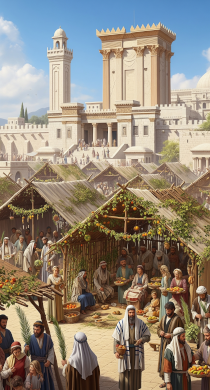
FEAST OF TABERNACLES / SUKKOT
WHAT ARE THE NAMES FOR THIS 7th FEAST?
Sukkot is plural for the Hebrew word sukkah, meaning “booth” or ‘hut” of entwined boughs, pavilion, tabernacle, tent. [1]
Feast of Ingathering is another name given to this feast. Exodus 23:16b, 34:22b.
A feast after all the harvest had been gathered in. Holiday Time!
WHERE ARE GOD’S INSTRUCTIONS RECORDED?
The first mention of Sukkot is Genesis 33:17. Jacob journeying back to the land of Israel after having spent 20 years with Laban in Haran. Having met with Esau and separating peacefully, he then settled for a time in Sukkot, on the east side of the Jordan river, and built shelters for his cattle.
Other instructions:- Exodus 23:16b. Lev 23: 33-44, Numbers 29:12-39, Deut 16:13-17
WHEN IS IT OBSERVED?
It begins on the 15th day of the 7th month of Tishri, and is celebrated for 7 days.
It is the climax of all the feasts. 2.
It is the 3rd feast all males were required to attend. Exodus 23:17, 34:23-24, Deuteronomy 16:16-17.
They had God’s assurance that their lands would remain safe. Exodus 34:23-24.
It is the final autumn feast held at the end of all the harvest, at the change of season, just before the winter rains are expected, and at the time of the full moon. Remember that Genesis 1:14 says the sun, moon and stars were given for signs, seasons, days and years. The word SEASONS does not only mean spring, summer, autumn, winter, but in Hebrew is:- Moed. exactly the same word as Feast! God uses His heavenly creations to let us know when His Feast days are happening! Psalms 104:19 – “He appointed the moon for seasons/feasts”
HOW LONG IS IT TO BE CELEBRATED?
It is to be kept as a permanent regulation for every generation. Leviticus 23:41. All 24 divisions of priests shared in the sacrificial duties during this feast, as they did for all the other feasts. 1 Chronicles 23-24.
Leviticus 23: 33-44
God commanded this feast to be a time for rejoicing and celebrating after all the harvest was in. Olives and grapes are the last of the harvest in August/September. (Grapes were pressed with hands and feet in Biblical times.) At the time they were feeling most comfortable they were required to leave home and live in a booth/ sukkah for a short time.
God required that choice fruit, palm fronds, thick branches and willow branches were to be incorporated into the celebrations. Leviticus 23:40.
It was a time for remembering and experiencing what living in a temporary shelter was like for whole families, including slaves and even foreigners. The Feast of Tabernacles/Sukkot offers an experience of what following God is like — feeling both insecure and incredibly blessed at the same time. [3]
The seven days are followed by an 8th day. The first and eighth day were complete rest days, ie:- High Holy Days that is:- Shabbats.
The importance of this feast is shown by the great number of required sacrifices offered during the feast week. Numbers 29:12-39. Each day 1 goat, 14 lambs, 2 rams and a decreasing number of bulls, 13 on the first day, decreasing by one each day, were offered in the Temple. Each sacrifice was offered with its appropriate grain offerings of flour/oil, and drink offerings of wine. The totals for seven days being: – 70 Bulls, 7 goats, 98 lambs, 14 rams. Totalling 189 animals.
Notice:- The combined totals are divisible by 7, meaning perfection and finality. The number 7 is included in this feast more than all the others. [4]
Genesis 10 mentions the beginnings of 70 nations. Therefore, in Hebrew thought … the priests were making the sacrifices on behalf of the nations of the world.
Genesis 46:26-27 mentions 70 descendants of Jacob.
During the Feast of Tabernacles, each 7th year, (the sabbatical year/Sh’mittah), the Torah was read aloud so everyone, including foreigners, could hear and learn how to obey God. Deuteronomy 31:9-13.
Solomon dedicated the newly built Temple, to the Lord, during the Feast of Tabernacles/Sukkot with great extravagance. 1 King 8:2, 2 Chronicles 5:3, 7:1-10. At that time the Sh’khinah glory of the Lord descended from Heaven to light the altar and fill the Holy of Holies! In the days that followed, this feast was viewed with great awe.
As you read through the books of Kings and Chronicles you will observe that there were periods in Israel’s history when the Lord’s Feasts were neglected or forgotten altogether and other periods when they were revived. After the return from the Babylonian exile the feast began to be observed again:- Ezra 3:4. Nehemiah 8:14-18.
Let’s imagine we were observing during the time of Jesus… NO significant rain had fallen since Passover, six and a half months ago, so during the Feast of Tabernacles there was a strong expectation and prayer, for the provision of abundant rain to come during the winter season.
Jewish pilgrims from all parts of the land and from foreign countries flocked to Jerusalem at this time. For protection they travelled in large groups of travellers bringing their tithes and offerings with them, (Deuteronomy16:16). It was a joyous trip with much singing and laughing along the way. The Psalms of Ascent (Psalms120-134) would have been sung as they toiled up the 24 kilometres of hot, dry barren, winding road from Jericho, (-200m), to Jerusalem, (785m). (About 1000 metres.) About eight hours travel. (Eg. From Motueka to Takaka Hill summit).
Upon arrival in Jerusalem, the pilgrims focused their energies upon building their booths within a Sabbath day’s journey of the Temple. In their sukkah, the elders, the pious, the Torah scholars, the great and the simple ordinary Jews, all became equal under God’s protection and in their unity to fulfil the will of God.
At sundown, the blast of the shofar from the Temple announced the arrival of the holiday and a full moon rose in the east in a clear autumn sky. [5]
At the close of the first day of Sukkot, Temple workers furiously began inserting sturdy poles into brackets in the walls of the Women’s courtyard. Over the poles they laid wooden boards, creating three balconies so that women could stand on the higher balconies, with the men below. An enormous candelabras, 23 – 46 metres tall, (75 -150 feet ), with four golden bowls on top, was positioned in the courtyard for the LIGHTING CEREMONY. Young priests with pitchers of oil scrambled up four ladders to light the thick wicks so that all of Jerusalem was filled with light like day. (The wicks were fashioned from the worn out linen garments of the priests). When the lamps were lit there was not a courtyard in all Jerusalem that was not illuminated by the light, because the Temple was situated on a high hill in Jerusalem and the lamps were tall and extended above the walls of the courtyard. Soon after the celebration was underway, a group of Levites gathered in the Court of the Israelites. Once the trumpets began sounding they moved through the Nicanor Gate to stand at the top of the 15 steps that lead down to the courtyard, playing their flutes, lyres, cymbals, and every sort of instrument in thunderous, heavenly music, while all the people joined in singing Psalms 120-134. With each new Psalm they descended a step. The most wondrous sight of all was the distinguished elders, with their long white beards, singing at the top of their lungs, dancing wildly, performing acrobatic feats and even juggling acts! This celebration was repeated every night from the second night and went on till dawn. [6]
Although not commanded in scripture, for at least 100 years before the time of Jesus the WATER LIBATION CEREMONY was celebrated every day after the first day. Shortly after dawn, accompanied by a joyous procession of music and worshipers, the High Priest went down to the pool of Siloam and filled a golden pitcher with water, then he proceeded with it back up to the Temple. At the same time another procession went to a small brook south of Jerusalem and gathered willow branches which were brought back to the temple and draped over the stone altar to form a canopy. As the High Priest entered through the Water Gate three blasts sounded on shofars and the priests repeated in unison the words of Isaiah 12:2-3, In Hebrew it sounded like this “See! God is my Yeshua, I am confident and unafraid; for Yah, Adonai is my strength and my song, and he has become my Yeshua!” Then you will joyfully draw water from the springs of Yeshua. He then proceeded to the great stone altar, where two silver basins drained to its base. He circled the altar once, then poured the water into one basin while wine was being poured into the other basin. Three blasts of the shofar immediately followed which signalled the start of the Temple music. The people listened as a choir of Levites sang the Hallel, (Psalms 113-118). At the proper time, the congregation waved their palm branches and joined in singing, “Save now, I pray, O Lord; O Lord, I pray, send now prosperity”, Psalms 118:25. At the same time the priests, with palm branches in hand, marched once around the altar, [7]
On the 7th day the Temple services reached a climax. The water pouring ritual took on greater importance because the need for rain was high in everyone’s thoughts.
On this day, instead of three blasts on the shofar, it was sounded three sets of seven blasts. On this day instead of one circuit around the altar, the priests made seven circuits. As they marched they sang the Hosanna verse of Psalm 118:25. All the while the people waved palm branches. For this reason the day was known as the HOSHANA-RABBAH or “GREAT HOSANNA”. [8]
Psalm 118 was viewed as a Messianic Psalm and as such gave the feast a Messianic emphasis. This is why Jesus, on his triumphal entry into Jerusalem, was greeted by the crowds waving palm branches and shouting “Hosanna”, which is Hebrew for Save now’ as in Psalm 118:25. (Matthew 21:8-9, Luke 19:38, John 12:13.)
Ancient Jewish theology connected the Water Libation ceremony with the Holy Spirit because in lsaiah 12:3-6 it says, “ With joy shall you draw water from the wells of salvation. They believed that the Holy Spirit came upon them and manifested Himself through great joy. The outpouring of the Holy Spirit in relation to salvation was a much repeated theme of the Old testament prophets. ( Isaiah 32:15, 59:21, Ezekiel 11:19, 36:27, 37:14, 39:29, Joel 2:28-29).
“If you never saw the celebration of the water-drawing, you never saw a celebration in your life”, said Rabbi Yehoshua ben Levi.
HOW DID JESUS FULFIL THIS FEAST?
Jesus was the word which became flesh and tabernacled with us. John 1:14.
Jesus was teaching in the temple courts during Tabernacles/Sukkot. John chapters7-9, John 7:14.
the seventh and final day of the feast, at the exuberant Hoshana Rabbah ceremony, Jesus took the opportunity to proclaim loudly, “If anyone is thirsty, let him come to me and drink. He who believes in me, as the scripture has said, out of his heart will flow rivers of living water.” John 7:37-39. Maybe He spoke up just after Isaiah 12:2-3 was quoted Adonai is my strength and my song, and he has become my Yeshua!” Then you will joyfully draw water from the springs of Yeshua. In other words Jesus said, I am the answer to your prayers, I am the Messiah. I can save you now so that you will never thirst for salvation again. The people would have understood that he was connecting himself to God the giver of living water! What discussion and debate that would have caused! They must have wondered if this Jesus could be the Messiah they were expecting?
The day after the Hoshana-Rabbah ceremony Jesus also proclaimed:- “I am the light of the world.” John 8:12. Jesus, who proclaimed to be the light giver also brought light into a blind man’s eyes. John 9:6-7. Wow! What dynamic discussions Jesus created that particular Feast of Tabernacles, probably just six months before he died at Passover.
FUTURE FULFILLMENT.
– Jesus tells us that the end of the age is at harvest time. Matthew 13:30, 39-43. James 5:7-8
– Remember one name for this feast is, “The Feast of Ingathering”. The people of Israel have been gathered back into their land over the past 100 years after being absent for over 1950 years, exactly as the prophets foretold would happen. Isaiah 27:12-13, Jer.23:7-8, Jeremiah 32:36-44, Ezekiel 36:24-38. This is a strong indication that the end is coming soon. (Since October 7th 2023, over 43,000 people moved to Israel. Made aliyah)
– Isaiah 4:4-6 tells us that after repentance and cleansing God will cause a smoking cloud by day and a fire by night to be over Mount Zion like a ‘hupah’/marriage canopy, or like a ‘sukkah”.
– Could this feast and the joy that permeates it be the marriage ceremony referred to in Revelations 19?
– Zechariah 2:5 also says that Adonai will be a wall of fire surrounding Jerusalem and He will be the glory within her.
– The prophesy of Haggai 2, given during the Feast of Tabernacles/Sukkot, focuses on the need to rebuild the second Temple. In this prophesy there is a promise that
“The glory of the new house will be greater than the old one”. Haggai. 2:9. (BY THE WAY: – Haggai’s name in Hebrew is Chag = meaning ‘Feast of the Lord’ [9]).
Maybe the LIGHTING CEREMONY of this feast was a rehearsal for the Glory of God, His Sh’khinah, which will fill the Temple in the future. Remember when the Glory of God filled the Tabernacle in the wilderness and the Temple built by Solomon, the priests could not stand, but bowed in worship. Exodus 40:34-35, 2 Chron. 7:1-3. Revelation 15:5-8, tells us the smoke from the Sh’khinah will also fill the Tent of Witness in heaven, and no-one will be able to enter. What an amazing glorious light of His Presence there will be!
– The Feast of Tabernacles/Sukkot will be kept in Jerusalem at a future time, and people from many nations will join in annually. Zechariah 14:16-19.
– There will be punishment for those nations who do not attend. Zechariah 14:17-19
– The Feast of Tabernacles foreshadows the Millennium when all the global harvest
of all the ages has ended. Until that day this feast will always be a rehearsal and a shadow, [10]
– Could the eighth day represent the new heavens and new earth promised in Revelation 21?
– The book of Revelations tells us that God’s Holy City and his Sh’khinah will dwell/ tabernacle with mankind and it mentions ‘Water of Life’, free of charge to anyone thirsty, Revelation 21:1-6
– Maybe the water themes of this feast are a rehearsal of the promises of Ezekiel 47:1-12 and Revelation 22:1-2.
HOW IS THIS FEAST SIMILAR TO MY CHRISTIAN JOURNEY?
2 Corinthians 5:1- 8. teaches that our bodies are like a tent, but we have a permanent house in heaven. A day is coming when we will receive a glorified body like Jesus received after his resurrection. So totally different, just like the transformation of a caterpillar into a butterfly. 2 Peter 1:13-14, Philippians 3:21, Romans 8:20-23,
The sukkah teaches us about the impermanence of our earthly life and that we are only temporary residents here on earth, but we’re on our way to a permanent home, the New Jerusalem. In this context, we don’t need to be concerned with collecting treasures here on earth.
We can remember the ways God protected and provided for the Israelites as they journeyed for 40 years in temporary shelters and this encourages us to trust God, however fragile our circumstances may be.
Jesus teaches us that we can have rivers of living water, His Holy Spirit, flowing from
our innermost being as we trust him. John 7:38.
Jesus teaches us also, that anyone can have the light of life and then be a light in this world. John 8:12, Matthew 5:14-16. Light exists for others not itself.
How Sukkot is observed today
In the days between Yom Kippur and Sukkot, family members can be observed carrying pieces of wood, branches, palms or rushes back to their homes. Happy chatter and the banging of hammers fill warm evenings as preparations for the feast draws nearer. The sukkah is made of no fewer than 3 walls which are intertwined with branches and the roof is constructed for daytime shade, but in such a way that the stars are visible at night. Decorations of harvest fruit and vegetables brighten the inside. Families eat their meals in the sukkah, invite guests in, and some even sleep in them. These little “huts” or “booths” are constructed on balconies or within backyards, in shop courtyards or on the footpath outside shops, in obedience to the commandment “You are to live in Sukkot for seven days”, Leviticus 23:42. For Jews, it is a time of great joy as they remember the intimacy of those forty years when God ‘tabernacled’ with them in the desert, sustaining them each day with manna from heaven, [11]
Before Sukkot, fathers spend time at the market deliberating over the selection and purchase of their four species:-the etrog (a type of lemon), a date palm (lulav), a myrtle branch (hadas), and willow branches (arava). They want the best their family can afford and after purchase these items are carefully kept fresh. During each synagogue services throughout the week, the four species are held and waved at certain times. The Torah scroll is placed in the centre of the synagogue and the congregants circle trie synagogue while singing Psalm 118. The concept of rejoicing is- stift strongly connected with the- synagogue services.
Even although THE LIGHTING CEREMONY and WATER LIBATION CEREMONY. do.
not exist today, the concept of rejoicing is still strongly connected with the Feast of Tabernacles, In the Middle Ages a new holiday arose Known as Slmctet Wah, meaning rejoicing in the Torah. It occurs on the 8th day. This post Biblical holiday preserves the traditions of rejoicing, and the reading of the Torah at the end of every seven years as instructed by Moses. Deuteronomy 31:9-13. Throughout the year, each Shabbat -the five Books of Moses are read portion by portion until finally by Simchat Torah the annual cycle of reading finishes and a new cycle begins. Every male in the synagogue on Simchat Torah is invited to read from the pulpit (aliyah). First the last Word chapters of Deuteronomy are read. They Include the-blessings Moses spoke over each tribe of Israel, then that scroll is rolled up and the Genesis scroll is opened with, “In the beginning God created the heavens and the earth. Afterwards the congregation marches around the synagogue with great rejoicing as the uplifted Torah scroll leads the procession. In this way they give honour, reverence and display dedication to God’s Word and His teachings. This procession sometimes spills out into nearby streets and all the way down to the Western Wall. [12]
In Jewish thinking the seven days of this feast represent the seven thousand years of man on earth and the eighth day represents a new beginning. Every year this thought is rehearsed.
Summary:
– Completion of all the harvest Great rejoicing. Everyone gathering to Jerusalem.
– The TO GO year Messianic Kingdom on earth.
– Keeping our focus on God’s kingdom and impermanence of this life.
Sources:-
1. Strongs Exhaustive Concordance- of the Bible.
2. Wake Up. By Arno Lamm & Emile-Andre Van Beckevoort. Page 295Wake Up.Page 408
3. Sitting at the Feet of Rabbi Jesus. By Ann Spangfer & Lois Tverberg. Page 121.
4. D.L. Shaw. The Three Feasts of Israel. The Feast of Tabernacles.
5. The Feasts of the Lord. By Kevin Howard & Marvin Rosenthal. Page 136-137
6. Chabad.org Tzvi Freeman + Eliyahu Kito
7. The Feasts of- the Lord. By Kevin Howard& Marvin Rosenthal Page 138-141.
8. The Feasts of the. Lord; By Kevin Howard; & Marvin Rosenthal. Page 138-143
9. D.L. Shaw; The Three Feasts of Israel. The Feast of Tabernacles.
10. Wake Up. By Arno Lamm & Emile-Andre Van Beckevoort. Page 295 Wake Up. Page 408
11. Sitting at the Feet of Rabbi Jesus. By Ann Spangler & Lois Tverberg. Page 122
12. The Feasts of the Lord. By Kevin Howard & Marvin Rosenthal. Page 143-145.
Jenny Milmine 2025.
BIRTH OF JESUS AT TABERNACLES/SUKKOT?
Bible scholars widely agree that Jesus was not born on December 25th.
During the fourth century C.E. Emperor Constantine declared Christianity to be the “offical religion of the Roman Empire”, and as he didn’t want unrest in his empire he tactically mixed the Christian feasts with pagan festivals. 1. December 25th happened to be an ancient feast to celebrate the return of the sun after the solstice. It had nothing to do with the birth of Jesus but it was adopted nonetheless. It seemed to later believers, that there was no real, evidence, indicating a better date. [2]
Some scholars believe Jesus was born during Tishri ( Sep/Qct) for the following reasons:-
– It is winter in Israel in December and shepherds do not watch their sheep outside at night at that time of year. (Luke 2:8).
– There were 24 courses of priests (1 Chronicles 24:1-19), each serving in the temple for two weeks per year: one early in the year and the other about six months later, not including Passover, Pentecost and tabernacles during which all priests- were on duty.
– Zachariah, father of John the Baptist, was of the 8th course called Abijah, (Luke 1:5, 1 Chronicles 24:10)
His first week of service would have been in the 10th week of the biblical year. If Elizabeth conceived shortly-after Zachariah’s return home, .- John was probably was conceived at the end of May. Thus be would have been born during Nisan (March/April), possibly at Passover that year.
– Jesus was born during a Roman census (Luke 2:1-7). The normal time for a Roman census was August to October. Jesus was six months younger than his cousin John, (Luke 1:26,36) , so, if John was born in Nisan, Jesus’ birth would be in Tishri ( Sep/Oct), possibly during one of the three autumn feasts.
If Jesus was born just before or during Tabernacles/Sukkot it would be in line with the themes of – Joy and of Emmanual (God with us) John 1:14 – the word became flesh (His body being an earthly Sukkah) and dwelt (Tabernacled) among us. [2]
– When the apostle John describes the birth of the Messiah, he paints it in the terms of Tabernacles,
John 1:4 [3]
1. Wake- Up; By Arno Lamm & Emile-Andre VanBeckevoort. Page 409
2. The Feasts of the Lord- (YHWH) by Marcia Malthas.
3. God’s Appointed Times. By Barney Kasdan.
JESUS BORN IN A STABLE?
The idea of a stable probably arose from the reference to a manger or feeding box in the narrative.
Luke 2:7.
Through unfamiliarity of middle eastern homes at the time of Jesus birth, inaccurate information was given to -sermons, art and books which have shaped our thinking over time, in the Biblical narrative there is no reference to a donkey, an ox, or a sheep. Also if Jesus had have been born in a stable or a cave that would have been in violation of Jewish purification rules.
– At the time in history when Jesus was born the word ‘inn’ was actually the name for the guest room of any Jewish home. It was situated at the front of the house and was large enough to accommodate people coming and going during the day, then at night, beds {sleeping mats] were unrolled and the space was used for sleeping.
Because of the census the household would have been overflowing with family members from out of town, therefore there was no room in the inn/guest room. Jesus was probably born in a storage room lower in the house, normally reserved for animals during winter and/or for the storage of harvest produce including oil, wine, grain, herbs, spices etc. There, a feeding, box/manger could have been cut into, the stone wall; and, being: empty, was available for a bed. This inn/guest room, was probably used every Feast season when relatives from out of town came in obedience to God’s command to attend the feasts three times a year. Some guests may have even slept on the roof if the weather was suitable. Maybe the shepherds, spread the angels “good news” to all the relatives in the house. – Travellers did however, stay at a caravanserai/khan (an inn with a central courtyard for travellers in desert regions), when there was a great distance between towns or destinations. Luke 10:34. Otherwise middle eastern hospitality took over and guests waited in the town square until they were welcomed into a persons home, even if they were unknown to each other. Biblical examples are:- Genesis 19:1-5, Judges 19:15-21, Matthew 10:11.
Jenny Milmine 2023
JEWISH HOLY DAYS
THE MAKING OF A BABY.
In 1979 Zola Levitt published a booklet called “The Seven Feasts of Israel’. Part 2 of the booklet was a fascinating account of how the feasts relate to the development of the baby in the womb. The following is an overview of Levitt’s findings written by J.R. Church. It testifies to the one who designed them both!
Zola Levitt discovered an amazing correlation between Jewish Holy Days and the gestation of a human baby, from conception to birth. While preparing for writing a book for new parents, Zola contacted a gynaecologist for some help in understanding gestation. During that session, the gynaecologist showed him a series of pictures, pointing to the first one (an egg and a sperm) and said, “On the fourteenth day of the first month, the egg appears.” The statement struck a chord in his Jewish mind because that was the date of Passover. He remembered the roasted egg his family table every Passover. Now, for the first time, he knew what it meant! Not wanting to lead the gynaecologist off from the subject at hand, he didn’t say anything, but continued to listen.
The gynaecologist continued: “The egg must be fertilised within 24 hours, or it will pass on.” This reminded Zolas of the Feast of Unleavened Bread and the seed or grain that ‘Tell into the ground and died” in order to produce a harvest, the firstfruits of which was presented to God. Next, the gynaecologist said, “Within two to six days, the fertilised egg attaches itself to the wall of the womb and begins to grow.” And , sure enough, the Jewish evangelist thought, “The Feast of Firstfruits is observed anywhere from two to six days after Passover!”
Next he was shown a photo of an embryo showing arms, hands, fingers, legs, feet, toes, a head, eyes, etc. The gynaecologist continued, “Around the fiftieth day, the embryo takes on the form of a human being. Until then, we don’t know if we have a duck or a tadpole.” Zola thought, “That’s Pentecost!”
The next picture showed the embryo at seven months. The gynaecologist said, “On the first day of the seventh month, the baby’s hearing is developed. For the first time it can distinguish sounds outside the womb.” Zola knew that was the date for the Jewish Festival of Trumpets.
The gynaecologist continued, “One the tenth day of the seventh month, the haemoglobin of the blood changes from that of the mother, to a self-sustaining baby.”
Zola thought, “That’s the Day of Atonement, when the blood was taken into the Holy of Holies I”
Next the gynaecologist said, “On the fifteenth day of the seventh month, the lungs become fully developed. If born before then, the baby would have a hard time breathing.” And Zola thought, “That’s the festival of Tabernacles, a time of celebrating the Temple home of the Shekinah glory or Spirit of God”. In the New Testament, the Greek term pneuma, normally translated as “breath”, is applied to the “Holy Spirit”.
Birth takes place on the tenth day of the ninth month. Eight days after birth, in Jewish families, a son is circumcised. Zola noted that the eight days of Hanukkah are celebrated right on schedule, nine months and ten days after Passover.
No human being could have understood the gestation period 3,500 years ago. The establishment of the Jewish Holy Days were given to Moses by Jehovah, himself. Its correlation with the human gestation period is not only remarkable; it proves “Intelligent Design.” It proves the existence of an intelligence beyond this world. It proves that there is a Creator God that guides the affairs of man.
0. 7 Festivals and a Fast – Introduction
1. 7 Festivals and a Fast – The Festival of Passover
2. 7 Festivals and a Fast – The Festival of Unleavened Bread
3. 7 Festivals and a Fast – The Festival of First Fruits
4. 7 Festivals and a Fast – The Festival of Pentecost or Shavuot
5. 7 Feasts and a Fast – The Festival of Trumpets
6. 7 Festivals and a Fast – The Fast of THE DAY OF ATONEMENT/ YOM KIPPUR
7. 7 Festivals and a Fast – The Festival of Tabernacles
8. 7 Festivals and a Fast – The Weekly Sabbath Festival
9. 7 Feasts and a Fast – Other Information
Other slides in this module:
- Life of Moses – Exodus, Leviticus, Numbers, and Deuteronomy
- 300-year gap between Joseph and Moses
- First 40 years of the life of Moses
- Thutmose I, the Pharaoh or king of Egypt
- Miriam kept eye on Moses after he had been placed as a baby in a boat
- Second 40 years of the life of Moses
- God spoke to Moses out of a burning bush
- Moses was asked to take off his sandals by God
- The third 40 years of the life of Moses
- Aaron’s Staff becomes a Snake
- The ten plagues of Egypt
- 1st Plague – Blood
- 2nd Plague – Frogs
- 3rd Plague – Lice or Gnats
- 4th Plague – Dung beetles
- 5th Plague – Pestilence
- 6th Plague – Boils
- 7th plague – Nut – Egyptian Goddess of the Sky
- 8th Plague – Locust
- Ninth plague – Darkness
- Tenth plague – Firstborn die
- Passover commemorates the Exodus from Egypt
- Moses the friend of God
- Pillar of Cloud by Day
- Pillar of fire by night
- The Chariots of the Egyptian army
- Moses crosses the Red Sea
- Moses’ older sister Miriam sings a song
- Waters of Marah and Elim
- Manna means ‘What Is It?’
- Water from The Rock at Massah
- Moses at Mount Sinai
- The Ten Commandments or Ten Words of God
- The Three groups of Annual Feasts of God
- The Festival of Passover
- The Festival of Unleavened Bread
- The Festival of First Fruits
- The Festival of Weeks or Pentecost
- The Festival of Trumpets or Feast of Shofars
- The Fast of Yom Kippur
- The Festival of Tabernacles
- The Weekly Sabbath Festival
- The Golden Calf, the idol made by Aaron
- Moses with the New Stone Tablets
- 1st five of the Ten Commandments
- 2nd five of the Ten Commandments
- Ark of God
- The High Priest of Israel
- Tabernacle of God
- Aaron and Miriam oppose Moses
- Exploring Canaan by 12 spies
- 37 years in the wilderness
- Aaron’s Rod that budded
- Speak to the Rock “Give Water”
- Death of Aaron
- The Bronze Snake
- Balak Summons Balaam
- Six cities of Refuge for Israel
- Daughters of Zelophehad
- Moses Blesses the Tribes with Three Sermons
- Moses lived for 120 years
- Caleb was the son of Jephunneh
- Joshua – The Fall of Jericho
- Questions and Answers 1-16
- Questions and Answers 17-32
- Questions and Answers 33-49
- Timeline for Life of Moses
- Next Module – Judges or rulers of Israel
- 7 Feasts and a Fast – Introduction
- 7 Feasts and a Fast – PASSOVER
- 7 Feasts and a Fast – UNLEAVENED BREAD
- 7 Feasts and a Fast – FIRSTFRUITS
- 7 Feasts and a Fast – PENTECOST
- 7 Feasts and a Fast – FEAST OF TRUMPETS
- A Fast – YOM KIPPUR
- 7 Feasts and a Fast – TABERNACLES
- 7 Feasts and a Fast – Weekly Sabbath
- 7 Feasts and a Fast – Other Information
- Rosh Hashanah or Yom Teruah (The Day of the Sounding of Shofar)
- Yom Kippur, means “Day of Atonement”
- The Jewish Festival of Sukkot
- Background Information – Life of Moses
- Resources – Life of Moses