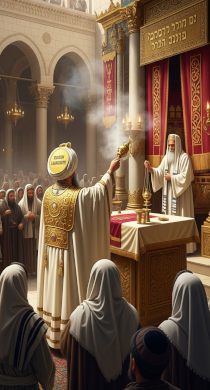
Introduction:
Yom Kippur, means “Day of Atonement,” is the most solemn and holy day in the Jewish calendar.
According to the sources, Yom Kippur is a day of “self-denial” (Leviticus 23-27) and day to be cleansed of one’s sins. It is observed eight days after Rosh Hashanah. Traditionally, it is believed that on Rosh Hashanah God inscribes names in the “books” and on Yom Kippur, the judgment entered in these books is sealed. A traditional greeting is “may you be inscribed in the book of life.
The days between Rosh Hashanah and Yom Kippur are called the “Days of Awe’. The prayers and fasting on Yom kippur are supposed to insure that through repentance, God seals the repenter in the book of life.
Restrictions on Yom
Yom Kippur is a fast day for adults. Males from the age of 13 and Females from the age of 12 are obligated to fast. It is the strictest of the Jewish year. The fast lasts for over 25 hours. Traditionally, the focus on Yom kippur is for spiritual elevation. One way to do this is to abstain from the physical and superficial pleasures. Consequently, these five physical activities are forbidden on Yom Kippur:
- Eating and drinking.
- Washing one’s body.
- Anointing oneself. One cannot wear jewelry, perfume or makeup.
- Wearing leather shoes.
- Marital relations.
It is customary to wear white on Yom Kippur. This symbolizes purity and calls to mind the promise that sins shall be made as white as snow (Isaiah 1:18). Some people wear a kittel, the white robe in which the dead are buried.
In Israel, the country comes to a standstill on Yom Kippur. Places of entertainment and stores are closed, there are no state-run television or radio broadcasts (not even the news), and public transport does not run. Solemnity on Yom Kippur in Israel is reinforced by memories of the 1973 war, when Egypt and Syria launched a surprise attack against Israel.
Customs the day before Yom Kippur:
Mikva/Ritual Bath
Traditionally, every Jew is required to immerse in a mikvah (ritual bath) on the day before Yom kippur.
Kaparot
It is an ancient custom to perform Kaparot before Yom Kippur. Kaparot can be performed any time between Rosh Hashana and Yom Kippur but the preferred time is just after dawn on the day before Yom Kippur. The Kaparot ritual involves taking a chicken in your right hand and revolving it over your head while reciting a prayer. Money is then donated to charity.
Eating before Yom kippur
The festive meal before the fast is called Seudah Mafseket (“final meal”). Traditionally, meat is not eaten during this meal, but poultry can be eaten. It is traditional to eat soup, but it is important to put as little salt and seasoning in the soup as possible. Before the meal a blessing is made for bread but not for wine.
To endure the fast many people give up caffeine for a period before Yom kippur.. For many people this helps to prevent headaches from fasting. Also it is important to drink plenty of water at regular intervals for the day before. It is important to leave time for the prefast meal. It must be eaten quite early (times change according to location and date)..
Bringing in the festival
After the meal it is customary to light memorial candles before candle lighting. When the Festival candles are lit, 18 minutes before sunset, these two blessings are recited:
Ba-ruch A-tah Ado-nai E-lo-hei-nu Me-lech Ha-olam Asher
Ki-deshanu
Be-mitzvo-tav Ve-tzvi-vanu Le-hadlik Ner Shel Shabbat veShel Yom
Hakipurim.Blessed are You, Lord our G-d, King of the universe, who has
granted
us life, sustained us, and enabled us to reach this occasion.Ba-ruch A-tah Ado-nai E-lo-hei-nu Me-lech Ha-olam
She-heche-ya-nu Ve-ki-yi-ma-nu Ve-higi-a-nu Liz-man Ha-zeh
Additionally, before entering the synagogue, it is customary for fathers to bless their children. Although there is no required formula for this blessing, it is customary for fathers to say:
May God make you like Efrayim and Menashe [for a son]; or, May God make you like Sarah, Rivkah, Rachel, and Leah [for a daughter].
Repentance/Teshuva
Traditionally, the day of Yom Kippur is devoted entirely to prayer. Repentance (teshuva) is the theme of Yom Kippur. It is believed that usually sins alienate one from God, but on yom kippur, repentance reconciles one with God.
The first Yom Kippur occurred when Moses descended Mount Sinai with the second set of Tablets of the Ten Commandments, a symbol of the renegotiated covenant between God and the Jewish People. It is believed that the Israelites alienated God by worshipping the golden calf. Moses ascended Mount Sinai to ask God for forgiveness. The Israelites repented by fasting during the day while Moses was on the mountain. On the tenth day of the Hebrew month of Tishrei (Yom Kippur), Moses descended Mount Sinai with the second Tablets.
God decreed the tenth day of the month of Tishrei as a day of atonement:
“Let it be a statute for you forever: in the seventh month, on the tenth of the month, you shall starve your vital energies and do no manner of work…. For on this day it shall bring atonement upon you, to purify you, before God shall you become pure of all your aberrations.” (Vayikra/Leviticus 16: 29-30)
Prayers on Yom Kippur
Prayer services on Yom Kippur are lengthy and solemn. Traditionally, most of the holiday is spent in prayer in the synagogue. These are the services:
The Evening of Yom Kippur:
- Kol Nidrei and Maariv
On Yom Kippur day:
- Shacharit
- The Torah Reading, including the book of Jonah
- Yizkor
- Musaf
- Mincha
- Neilah
- Maariv
Breaking The Fast:
When Yom Kippur finishes, it is traditional to break the fast with a celebratory meal. Afterwards, it is customary to start to build the Sukkah for the next holiday of Sukkot. By doing this it is possible to go straight from atonement for sins into doing a mitzvah, a good deed, making a fresh start for the new year.
The Day of Atonement is fulfilled with the Messiah. This concept is taught in the Old Testament in Isaiah 52:13–53:12. Here the Messiah is pictured as the final Day of Atonement sacrifice which contains the concept of substitution and the concept of atonement. Contextually, Isaiah 52:13–53:12 is not only a prophecy of the Crucifixion, it is also the words of Israel’s confession of her national sin for salvation as a nation.
The key element of the Day of Atonement is the element of affliction. In the biblical practice, it was the affliction of the soul. In the Jewish practice, it is the affliction of the body. The Day of Atonement is to be fulfilled by the Great Tribulation where both types of affliction will be present. It is no accident that the Tribulation is often referred to in the Scriptures by the term affliction. It is a time of tremendous affliction in fulfillment of the affliction of the Day of Atonement. During the Great Tribulation, there will be the affliction of both the body and the soul.
The affliction of the body of Israel is detailed by Hosea 5:15–6:3 when Israel as a nation will be afflicted during the course of the Great Tribulation. Hosea 5:15 states: I will go and return to my place, till they acknowledge their offence, and seek my face: in their affliction they will seek me earnestly.
Zechariah 13:8–9 also details this affliction that will destroy two-thirds of the nation of that day and leads to a second type of affliction: the affliction of the soul.
The affliction of the soul is given in Zechariah 12:10–13:1 when the Spirit is poured out on the people of Israel, and they will then “look unto the One they pierced and mourn for Him as one mourns for an only son.” The national regeneration of Israel will come by means of the afflictions of the Great Tribulation and that, in turn, will lead to Israel’s confession of her national offense with the words of Isaiah 53:1–9.
The Feast of Trumpets is to be fulfilled by the Rapture of the Church, and the Day of Atonement is to be fulfilled by the Tribulation. Just as the Feast of Trumpets precedes the Day of Atonement, by the same token, the Rapture will precede the Great Tribulation.
Other slides in this module:
- Life of Moses – Exodus, Leviticus, Numbers, and Deuteronomy
- 300-year gap between Joseph and Moses
- First 40 years of the life of Moses
- Thutmose I, the Pharaoh or king of Egypt
- Miriam kept eye on Moses after he had been placed as a baby in a boat
- Second 40 years of the life of Moses
- God spoke to Moses out of a burning bush
- Moses was asked to take off his sandals by God
- The third 40 years of the life of Moses
- Aaron’s Staff becomes a Snake
- The ten plagues of Egypt
- 1st Plague – Blood
- 2nd Plague – Frogs
- 3rd Plague – Lice or Gnats
- 4th Plague – Dung beetles
- 5th Plague – Pestilence
- 6th Plague – Boils
- 7th plague – Nut – Egyptian Goddess of the Sky
- 8th Plague – Locust
- Ninth plague – Darkness
- Tenth plague – Firstborn die
- Passover commemorates the Exodus from Egypt
- Moses the friend of God
- Pillar of Cloud by Day
- Pillar of fire by night
- The Chariots of the Egyptian army
- Moses crosses the Red Sea
- Moses’ older sister Miriam sings a song
- Waters of Marah and Elim
- Manna means ‘What Is It?’
- Water from The Rock at Massah
- Moses at Mount Sinai
- The Ten Commandments or Ten Words of God
- The Three groups of Annual Feasts of God
- The Festival of Passover
- The Festival of Unleavened Bread
- The Festival of First Fruits
- The Festival of Weeks or Pentecost
- The Festival of Trumpets or Feast of Shofars
- The Fast of Yom Kippur
- The Festival of Tabernacles
- The Weekly Sabbath Festival
- The Golden Calf, the idol made by Aaron
- Moses with the New Stone Tablets
- 1st five of the Ten Commandments
- 2nd five of the Ten Commandments
- Ark of God
- The High Priest of Israel
- Tabernacle of God
- Aaron and Miriam oppose Moses
- Exploring Canaan by 12 spies
- 37 years in the wilderness
- Aaron’s Rod that budded
- Speak to the Rock “Give Water”
- Death of Aaron
- The Bronze Snake
- Balak Summons Balaam
- Six cities of Refuge for Israel
- Daughters of Zelophehad
- Moses Blesses the Tribes with Three Sermons
- Moses lived for 120 years
- Caleb was the son of Jephunneh
- Joshua – The Fall of Jericho
- Questions and Answers 1-16
- Questions and Answers 17-32
- Questions and Answers 33-49
- Timeline for Life of Moses
- Next Module – Judges or rulers of Israel
- 7 Feasts and a Fast – Introduction
- 7 Feasts and a Fast – PASSOVER
- 7 Feasts and a Fast – UNLEAVENED BREAD
- 7 Feasts and a Fast – FIRSTFRUITS
- 7 Feasts and a Fast – PENTECOST
- 7 Feasts and a Fast – FEAST OF TRUMPETS
- A Fast – YOM KIPPUR
- 7 Feasts and a Fast – TABERNACLES
- 7 Feasts and a Fast – Weekly Sabbath
- 7 Feasts and a Fast – Other Information
- Rosh Hashanah or Yom Teruah (The Day of the Sounding of Shofar)
- Yom Kippur, means “Day of Atonement”
- The Jewish Festival of Sukkot
- Background Information – Life of Moses
- Resources – Life of Moses