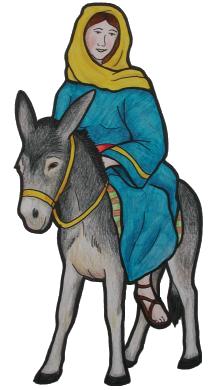
At the time of Jesus’ birth, people traveled by foot, by animal, or in a cart. The journey from Nazareth to Bethlehem took four to six days over rough tracks with wild animals and robbers. People usually traveled in groups for their own protection. Donkeys or asses were the normal animals used to carry loads and are still used in many countries today. Horses were only used by the rich or as a war animal.
The hand of God is seen everywhere—even here—with His using a Roman census to bring Jesus to be born in Bethlehem.
Jesus, to be the Messiah and Savior of the world, had to fulfill a number of prophecies. Can you think of any?
Background Reading: – Mary travels with Joseph
5 He went there to be registered with Mary, who had been promised to him in marriage and was pregnant.
Luke 2:5
More Information:
We do not know the name or breed of the donkey that carried Mary, who was pregnant at the time with Jesus.
The trip from Nazareth to Bethlehem could have taken four to six days on foot to cover the 120 km (75-mile) journey.
Traveling in winter, such as December, would have been unlikely because of the cold and rain.
If the census was taken over a period of time, then Joseph and Mary could have gone to Bethlehem and been in Jerusalem during one of the three feasts, which all Jewish males were compelled to attend.
The three feasts are:
1. Unleavened Bread (which includes Passover): in spring.
2. Pentecost: in late spring.
3. Tabernacles: in autumn (see Leviticus 23:24; John 1:14). Jesus “dwelt among us.” Literally, the meaning is—Jesus “tabernacled among us.”
Jerusalem covered one square mile and had an estimated population of 200,000, with one million pilgrims annually, mainly arriving for the religious feasts.
Other slides in this module:
- The angel Gabriel spoke to Mary about the birth of Jesus
- Mary got a visit from the angel Gabriel
- Elizabeth got a visit from Mary
- Mary offered a hymn of praise to God
- An angel of the Lord appeared to Joseph in a dream
- Joseph goes to Bethlehem
- Mary traveled with Joseph on a donkey
- Jesus a newly born baby
- Shepherds keeping watch
- Angels praised God for the birth of Jesus
- Jesus at 40 days old was taken to the Temple
- Simeon blesses Jesus
- Anna the Prophetess
- Magi traveled from the East to find Jesus
- The visit of the Magi to King Herod
- Magi followed the star to a house
- Jesus as a child in a house
- Joseph takes Jesus and escapes to Egypt
- King Herod the Great plans how to kill Jesus
- The return from Egypt to Nazareth
- Jesus about twelve years old
- The cross is still to come
- Questions and Answers 1-11
- Questions and Answers 12-23
- Timeline for Birth of Jesus – The Christmas Story
- Timelines
- Background Information – Birth of Jesus – The Christmas Story
- Resources – Birth of Jesus
- Next Module – Ministry of Jesus » »